Hebrew verb tables are a foundational tool for understanding how action is expressed in
Hebrew. Unlike languages that rely on a single global set of endings, Hebrew uses a family of patterns
called binyanim (patterns or stems) to convey nuances of meaning such as causation, reflexivity,
or passive voice. A conjugation table groups the verb forms by person, number, tense, and
binyan, allowing learners to see at a glance how a root morphs across states of action.
If you are new to Hebrew, think of a root as a small bundle of consonants—typically three
letters—that carry core semantic content. A binyan then adds
a particular pattern of vowels and sometimes additional letters to that root, signaling tense, voice, or intensity.
The goal of this guide is to spell out how those patterns appear in concrete conjugation tables,
with careful attention to both modern usage and traditional forms.
Overview: Hebrew verbs, roots, and patterns
Most Hebrew verbs derive from triconsonantal roots (three-consonant sequences). A single root such as
כתב (K-T-B, “to write”) can appear in several binyanim, each with its own flavor:
- Qal — the basic, active voice and the most common pattern for simple actions.
- Niphal — often the passive or reflexive counterpart of the Kal (to be written, to occur, etc.).
- Piel — a more intensive or causative pattern (to cause to write, to inscribe in a more deliberate way).
- Pual — the passive counterpart of Piel.
- Hiphil — a causative pattern (to cause to do something, to cause action).
- Hophal — passive counterpart of Hiphil.
- Hitpael — a reflexive or reciprocal pattern with a sense of involvement (to engage in an activity with oneself or with relation to others).
In practice, Hebrew learners frequently begin with the Qal conjugations (the default pattern),
then expand to Niphal and a few other stems as needed for reading, listening, and
speaking in different registers. You’ll notice that the tables below emphasize
both the structure (which suffixes or prefixes appear where) and the forms you’ll actually see
in modern Hebrew texts and speech.
Conjugation fundamentals: person, number, gender, and tense
A Hebrew verb form is determined by four main axes:
- Person — first, second, or third person (I, you, he/she/they).
- Number — singular or plural.
- Gender — masculine or feminine (visible in many forms, especially in past and present forms of singular and several plural forms).
- Tense/Aspect — Hebrew traditionally distinguishes Perfect (past) and Imperfect (future/unclear aspect), plus present and imperative forms. Modern usage also emphasizes progressive present forms and colloquial future constructions.
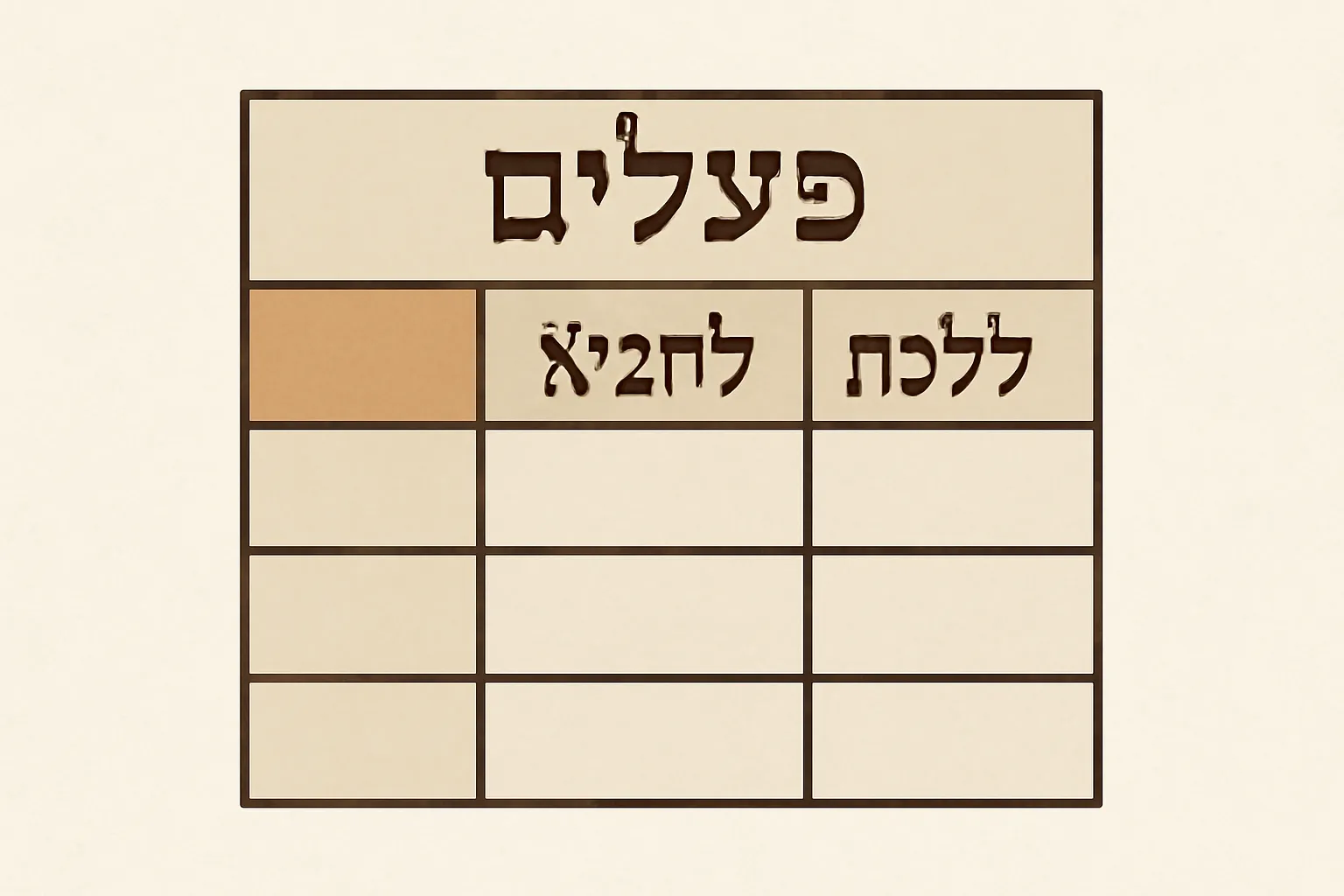
A typical table for a binyan will arrange forms by person (1st, 2nd, 3rd),
number (singular, plural), and, as applicable, gender (masculine, feminine).
You will also see Hebrew script forms alongside transliteration to help you
connect the pronunciation with the written form.
Sample tables: a focused look at Qal and Niphal with a single root
Below are representative tables that use the canonical root כתב (K-T-B, “to write”). The forms shown
are common in Biblical and modern Hebrew, with diacritics sometimes omitted in everyday writing.
Table 1: Qal Perfect (Past) for כתב
The Qal Perfect is the standard “past tense” paradigm. The forms are given in Hebrew script with a transliteration.
| Person | Hebrew (Past) | Transliteration | Notes |
|---|---|---|---|
| 1st person singular | כתבתי | katavti | I wrote |
| 2nd person masculine singular | כתבת | katavta | You (m) wrote |
| 2nd person feminine singular | כתבת | katavta | You (f) wrote — vowels differ in pronunciation; written form looks the same |
| 3rd person masculine singular | כתב | katav | He wrote |
| 3rd person feminine singular | כתבה | katvah | She wrote |
| 1st person plural | כתבנו | katavnu | We wrote |
| 2nd person plural | כתבתם | katavtem | You all (m) wrote |
| 2nd person plural feminine | כתבתן | katavten | You all (f) wrote |
| 3rd person plural | כתבו | katvu | They wrote |
Table 2: Qal Imperfect (Future) for כתב
The Qal Imperfect (future) uses prefixes to indicate the subject. Vowel patterns vary by vowelization and dialect, but the basic prefix system is stable.
| Person | Hebrew (Future) | Transliteration | Notes |
|---|---|---|---|
| 1st person singular | אכתוב | ekhtov | I will write |
| 2nd person masculine singular | תכתוב | tiktov | You (m) will write |
| 2nd person feminine singular | תכתבי | tichtivi | You (f) will write |
| 3rd person masculine singular | יכתוב | yikhtov | He will write |
| 3rd person feminine singular | תכתוב | tichtov | She will write (vowel patterns differ in practice) |
| 1st person plural | נכתוב | nikhtov | We will write |