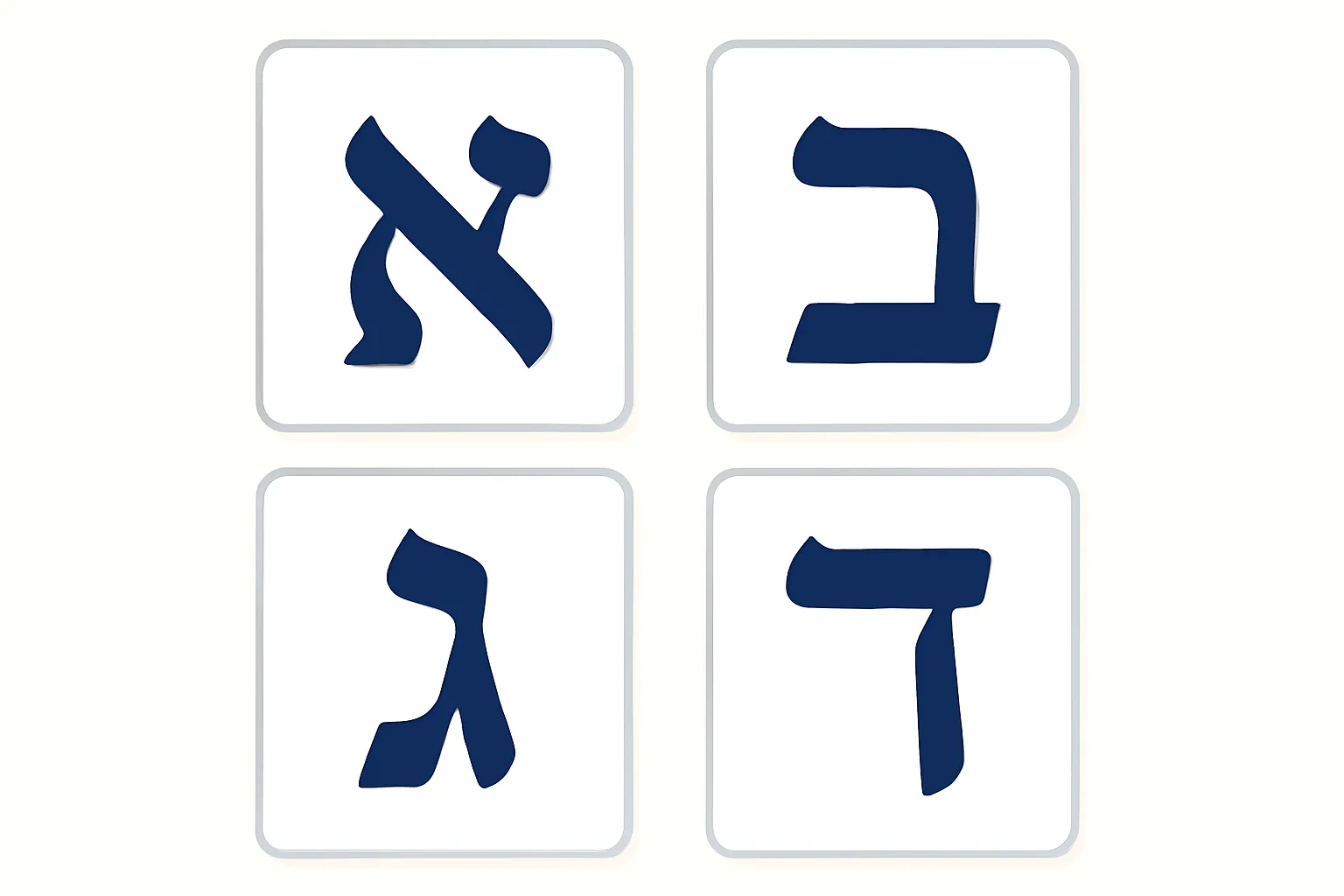
Hebrew Alphabet Flashcards: Learn the Alef-Bet Fast is a comprehensive guide designed to help beginners and self-learners accelerate their familiarity with the Hebrew script. Flashcards are a time-tested tool for mastering a new alphabet because they combine visual cues, quick recall, and spaced repetition. In this article, you will find a detailed look at how to use flashcards to learn the 22 Hebrew letters, the five final forms, the role of niqquot (vowel points), and a variety of card formats that can broaden your understanding beyond mere letter recognition. Whether you study with physical flashcards, digital apps, or a mixed approach, these techniques are designed to help you internalize the Alef-Bet quickly and confidently.
Understanding what makes Hebrew alphabet flashcards effective
Flashcards are most effective when they engage multiple senses and reinforce recall through spaced repetition. For the Alef-Bet, this means pairing each letter with its name, its typical sound, and visual features. Because modern Hebrew mostly uses consonants with optional vowel marks, flashcards that emphasize the letter identity and the sound value without overwhelming the learner with too many diacritics at once are often the most practical starting point. In addition, flashcards can be structured to highlight final forms (sofit letters) and to introduce situational letter behavior in words. As you progress, you can layer in more complex information, but the core aim remains: quick recognition, reliable recall, and a stable mental map of the alphabet.
Overview of the Alef-Bet and its special features
The Hebrew alphabet consists of 22 distinct letters. A handful of notes about the structure help you design better flashcards:
22 letters form the basic alphabet, used for printing modern Hebrew and everyday writing.
5 letters have final forms when they appear at the end of words: kaf sofit (final Kaf), mem sofit (final Mem), nun sofit (final Nun), pe sofit (final Pe), and tsadi sofit (final Tsadi).
Names and sounds of letters are often taught together, because the name can cue the sound and vice versa.
Vowels (niqquot) are usually omitted in everyday writing but are essential for beginners or for showing precise pronunciation. Flashcards can isolate consonant identity first, then gradually add vowel information as needed.
Some letters share similar shapes or sounds in various contexts; for example, bet vs. vet and kaf vs. kaf sofit, so well-designed cards help prevent confusion.
Variations of Hebrew alphabet flashcards to widen understanding
To maximize retention and adaptability, you can deploy multiple variations of flashcards. Each variation targets a different facet of learning, and together they create a robust, multi-angle brush-up of the Alef-Bet. Below are practical formats you can mix and match.
Front: the consonant letter with optional vowel points (for beginners, you can place niqquot on a separate card set later).
Back: the vowel sounds associated with the diacritics (e.g., kamatz, pataḥ, segol), along with a simple transliteration when appropriate.
Mnemonic-based cards
Front: the letter silhouette with a mnemonic image or phrase (e.g., a quick visual cue for the shape).
Back: the name, sound, and a vivid mnemonic story that links the letter’s shape to its sound or to a memorable object or concept.
Word-context cards
Front: a short Hebrew word that begins with the target letter or uses it prominently.
Back: the letter highlighted in the word, its name, and a pronunciation guide for the word so learners see practical usage.
Image and object association cards
Front: the letter and a small picture that starts with that letter in Hebrew (e.g., aleph with an image of an apple, if you want a bilingual approach).
Back: the name, a note on the sound, and a translation or transliteration.
Color-coded category cards
Front: the letter with a color tag (for example, consonants that are gutturals in one color, plosives in another).
Back: the category explanation, with tips for distinguishing tricky pairs (e.g., bet vs. vet, kaf vs. khaf in other languages).
Digital versus physical variants
Physical cards are tactile, portable, and do not require devices. They’re excellent for classroom settings or on-the-go study.
Digital flashcards (via apps like Anki, Quizlet, or custom decks) leverage spaced repetition algorithms to optimize review intervals and adapt to your pace.
Hybrid approaches blend physical and digital cards, synchronizing progress across formats and letting you choose the most efficient study moment for you.
Practical guidelines for creating your own Hebrew flashcards
Whether you build your own deck or curate one from a site, you’ll want a consistent framework so your brain forms stable associations with each letter. Below are practical guidelines to maximize learning outcomes.
Start simple with letter identity and name, then gradually add sound and vowels as you become confident.
Be consistent about the card structure so you can rely on muscle memory and rapid recall rather than re-learning format.
Use spaced repetition to optimize intervals between reviews. Apps that automate the SRS schedule are especially helpful for long-term retention.
Include context by embedding example words and short phrases on some cards so learners connect isolated letters to real usage.
Incorporate variety by mixing card types to prevent boredom and keep the learning process engaging.
How to organize a deck for speed learning
Group the 22 letters into categories (e.g., by shape similarity, by their place in the alfabet, or by sound families) to reduce cognitive load during initial rounds.
Create a “core” set of cards you review daily for the first two weeks, ensuring consistent exposure to each letter, name, and basic sound.
Maintain a separate “vowels” deck that you add gradually after you’ve mastered the consonant identities.
Label and track your progress with a simple system (e.g., color-code cards you’ve mastered vs. those you’re still practicing).
Digital tools and recommended practices for Hebrew flashcards
Digital systems can dramatically enhance how quickly you pick up the Alef-Bet, thanks to repetition schedules, searchability, and multimedia support. Here are key considerations when choosing or building digital Hebrew flashcards.
Spaced repetition is the core advantage of digital decks. Aim for daily practice in short sessions rather than long, infrequent marathons.
Look for decks that offer optional pronunciation audio so you can hear authentic Hebrew pronunciation and adjust your listening feedback.
Prefer decks that allow you to add example words or short phrases to the back of a card, so you connect letters to real usage.
Support for niqquot can be crucial for beginners; ensure you can enable or disable vowel points as needed.
Sync across devices is convenient for on-the-go review during commutes or lunch breaks.
How to practice with flashcards for rapid Alef-Bet acquisition
Below is a practical workflow for learners who want to maximize speed without sacrificing retention. You can adapt this approach to physical cards, digital decks, or a hybrid method.
Daily short sessions (10–15 minutes) beat longer, irregular study blocks. Consistency is more important than duration.
Begin with letter identity on day 1–3, focusing on recognition and recall of the letter name and basic sound.
Introduce final forms after you’re comfortable with primary letter identities; this helps prevent confusion later on when reading words.
Incorporate vowels gradually as you begin reading simple Hebrew words. Vowels provide helpful cues without overwhelming beginners.
Apply what you learn by noting example words for each letter and pronouncing simple phrases containing the target letter.
Review and reflect weekly, adjusting the deck to reinforce letters that still feel uncertain or resemble each other too closely.
Common learning challenges and how to overcome them
Every learner encounters obstacles. Anticipating these challenges and having concrete strategies helps you keep moving forward with confidence.
Confusing letters (e.g., bet/vet, kaf/khaf, mem/yod variants). Pair similar shapes with distinct mnemonic cues and ensure you practice distinguishing features, such as the presence or absence of a dagesh and subtle stroke differences.
Overwhelm from vowels too early. For many learners, focusing on consonant identity first prevents cognitive overload. Add niqquot only after comfortable with the consonants.
Final forms memory. It helps to study the five final forms as a separate group with their own mnemonic cues, then integrate them into reading practice.
Transliteration dependence. Use transliteration only as a temporary aid and gradually rely on native pronunciation to deepen accuracy.
Inconsistent review. If you skip days, you lose momentum. Use a reminder system or a quick 5-minute daily routine to keep the habit intact.
Sample card templates you can implement today
Here are concrete templates you can copy into your deck builder, whether you are creating physical cards or digital ones. Each template follows a consistent, repeatable pattern to reinforce memory.
Template 1: Letter identity and name
Front: Hebrew letter (e.g., א)
Back: Name (e.g., “Aleph”), sound cue (often silent or glottal stop), short example word (e.g., “אמא” for mother).
Template 2: Letter with pronunciation clue
Front: Letter + a basic sound cue (e.g., “Aleph — glottal stop”)
Back: Name, transliteration (if used), and a simple phonetic guide.
Template 3: Final form emphasis
Front: Non-final letter (e.g., ך for kaf sofit)
Back: “Final form: kaf sofit” + an example word showing the final form (e.g., «מַכְתָּב» or other simple word depending on level).
Template 4: Niqquot-inclusive card
Front: Letter with vowel points (e.g., א with pataḥ = אָ)
Back: Letter name, pronunciation guide, and common words using the vowel pattern.
Template 5: Mnemonic-based card
Front: Letter + image or cue
Back: Name, sound, mnemonic explanation, and a short step-by-step association.
Incorporating flashcards into a broader Hebrew learning plan
Flashcards are most powerful when used as part of a holistic learning strategy. Consider integrating flashcards with other resources and activities to create a well-rounded approach to learning Hebrew.
Listening practice with native speakers or audio resources helps align your recognition with authentic pronunciation.
Speaking drills focusing on the consonant sounds and simple words reinforces memory through production.
Reading practice with short Hebrew texts builds fluency and helps you apply the Alef-Bet in context.
Writing exercises to reinforce letter shapes and ordering when forming words becomes more natural after you have a solid memory base.
Vocabulary building in parallel with the alphabet creates meaningful connections between letters and real language use.
To stay motivated and measure progress, you can implement a simple, transparent tracking system. This helps you see where to focus next and provides a tangible sense of advancement.
Keep a log of letters mastered each week and the types of cards that were most effective for you.
Set weekly goals, such as “master all 22 letter identities” or “read a short Hebrew word without vowel marks.”
Periodically test yourself with a mixed deck to simulate real-world recall and maintain accuracy across all letters.
Advanced tips for accelerated mastery
For learners who want to push their Alef-Bet mastery further, these advanced tips can yield faster results without sacrificing long-term retention.
Interleave practice by mixing flashcards from different categories within a single session (e.g., letter identity, final forms, vowel cues) to strengthen flexible retrieval.
Use storytelling to connect letters with memorable narratives. For example, create a short story where each letter appears in sequence and appears in a familiar context. This can boost recall through narrative linkage.
Construct mini-challenges such as “speed rounds” where you try to identify as many letters as possible in a short time, followed by a calm review to correct mistakes.
Integrate reading practice early by using simple Hebrew words that contain the target letters. This helps to anchor letter recognition in meaningful text.
Customize mnemonic cues to fit your imagination. If a particular image or association resonates more with you, adapt it. Personal relevance boosts memory.
Role of teachers, tutors, and study communities
While self-study with flashcards is highly effective, guidance from a teacher or study group can amplify results. A few ways to leverage expert or community support include:
Working with a tutor to troubleshoot persistent confusion between similar letters.
Participating in a study group to practice reading aloud short Hebrew texts together and to compare mnemonic strategies.
Sharing your flashcard decks with peers and receiving feedback on card quality, balance of content, and clarity of mnemonics.
Common misconceptions about the Alef-Bet and flashcards
Addressing common myths can prevent stalls in progress. Here are a few to keep in mind as you work with flashcards.
Hebrew letters are learned once and forever. In reality, fluent reading requires ongoing practice, especially when encountering unfamiliar vowel patterns or word forms.
All letters look alike. While some letters share similar shapes, clear mnemonic cues and repeated exposure help distinguish them quickly with practice.
Vowels are unnecessary. For beginners, niqquot provide crucial guidance for correct pronunciation and читability. They can be phased out gradually as confidence grows.
Flashcards substitute for real reading. Flashcards are a powerful tool, but they work best in combination with reading practice, listening, and writing exercises.
Conclusion: achieving fluency with the Alef-Bet through thoughtful flashcards
Hebrew Alphabet Flashcards offer a practical, efficient pathway to internalize the Alef-Bet and lay a strong foundation for reading, writing, and speaking modern Hebrew. By using a diversity of flashcard variations, you can tailor the learning experience to your style, gradually introduce niqquot without overwhelming yourself, and connect letters to real words and meanings. A well-structured deck, combined with consistent practice and a little creativity, can accelerate your progress beyond what rote memorization alone could achieve. Whether you prefer physical cards you can hold in your hands or digital decks that adapt to your schedule, the goal remains the same: build quick recognition, reliable recall, and a flexible skill set that opens the door to Hebrew literacy.
Remember, the journey from recognizing a single letter to reading simple Hebrew text is a stepwise process. With a thoughtful approach to flashcard design, a steady practice routine, and a willingness to adapt as you learn, you can master the Alef-Bet in a fraction of the time you might expect. Use the variations described above to keep your study fresh and engaging, and you’ll find that learning Hebrew alphabet flashcards becomes not only practical but also enjoyable and empowering.