Hebrew Vowel Chart: A Complete Guide to Hebrew Vowels, Pronunciation, and Reading
The Hebrew vowel chart is a compact map of how niqqud marks work, what sounds they represent, and how readers decode written Hebrew. This article is designed as a practical, comprehensive resource for learners, teachers, linguists, and curious readers who want to understand not only the symbols themselves but also how they influence pronunciation and reading. Whether you are starting from scratch or refreshing your knowledge, you will find clear explanations, examples, and study strategies that apply to both Modern Hebrew and Biblical/Halakhic Hebrew.
What is a Hebrew vowel chart and why does it matter?
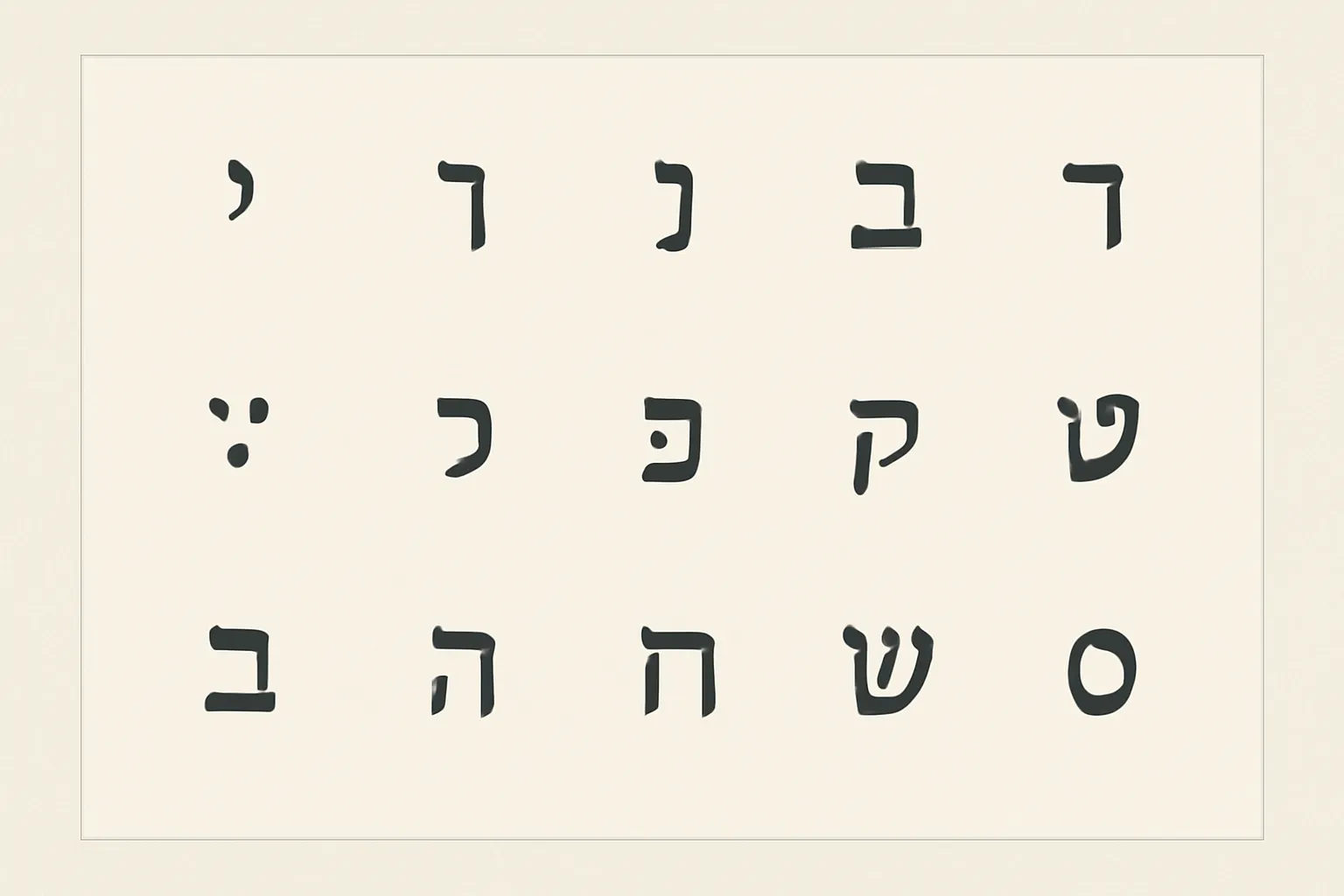
A vowel chart is a structured presentation of vowel signs (niqqud) that accompany consonants in written Hebrew. Unlike many alphabetic systems, Hebrew uses diacritic marks placed above, below, or inside consonants to indicate vocalic information. These marks are collectively called niqqud (plural of niqqud; singular: niqqud). In everyday Modern Hebrew, many texts are written without niqqud, assuming the reader will rely on context, morphology, and common vocabulary. Still, the vowel chart remains essential for:
learning correct pronunciation of new words
studying biblical texts that retain full vowel markings
teaching reading to children or new speakers
analyzing phonological patterns across roots and patterns
In this guide, you will encounter a carefully organized set of sections, each focusing on a particular vowel sign or related concept. We will consistently emphasize sound along with orthography, and we will highlight reading strategies that help you interpret vowels in real texts.
Core concepts: niqqud, matres lectionis, and modern usage
Before diving into the individual signs, it helps to establish two foundational ideas: the vowel signs themselves and the use of matres lectionis.
Niqqud are the set of diacritic marks that indicate vowel quality or absence. They are written with a consonant and a vowel sign, forming a syllable nucleus that guides pronunciation.
Matres lectionis are consonants that sometimes stand in for vowels. The most common letters used this way are א, ה, ו, and י. In many texts, these letters help signal vowel length or timbre without niqqud, which is one reason adult readers may still be able to read unvocalized Hebrew with good accuracy.
Modern Hebrew typically omits niqqud in everyday writing, relying on reader knowledge of vocabulary and grammar. In education, children’s books, and language-learning materials, niqqud is present to teach correct pronunciation and to disambiguate homographs.
Historical vowels exist in Biblical and Tiberian traditions, where the vowels are more richly described by grammarians. In contemporary learning, you will often encounter both modern conventions and historical descriptions as a bridge to older texts.
The main niqqud signs: a practical, alphabet-level overview
The following overview lists the most common vowel signs, their approximate sounds in modern usage, and simple examples to illustrate how each mark modifies a consonant. In each bullet, you will find the symbol name, a brief description of the sound, and a short transliterated example for clarity.
Pataḥ (ַ) — typically /a/ as in the father vowel, a short “ah” sound. Example take the consonant B with pataḥ: בַ would sound like “ba” in a syllable. Use this sound when you encounter the pataḥ under a consonant in simple words and syllables.
Qamatz (ָ) — commonly /a/ but longer or tenser than Pataḥ, especially in certain phonological environments. A typical transliteration is /aː/ or a longer /a/. The combination כָ would be pronounced roughly as “ka” with a longer A in many contexts.
Segol (ֶ) — usually /e/ as in the English bed, a short, crisp vowel. The sequence מֶ would be read as “me” in a syllable rather than a hard /e/ carried across multiple syllables.
Tzeire (ֵ) — generally /e/ as in say, often realized as /eɪ/ in older phonology or simply /e/ in Modern Hebrew. The form טֵ would sound like “te” with a steady /e/ vowel.
Hireq (ִ) — the i vowel, typically /i/ as in machine or the long “ee” in see. Example: סִ would be read “si/see” depending on context.
Shva (ְ) — a flexible mark that can be silent or pronounced as a very short or unstressed /ə/ or /1/ depending on the grammatical and phonological context. In modern teaching, it is often treated as silent unless a special pronunciation pattern calls for a vowel.
Holam (ֹ) — a rounded /o/ sound, similar to the English oh. It is a fairly prominent vowel, and you’ll see it as a dot above the letter in many texts, or paired with ו as the traditional standalone holam.
Shuruk (וּ) — a /u/ sound formed by a vav with a dot in the middle. This is the modern way to indicate the “u” sound in Hebrew. An example syllable זוּ would sound like “zu” with a clear /u/.
Kubutz (ֻ) — another representation of /u/, typically a dot-shaped marker under a consonant. It is less common in everyday Modern Hebrew, but it remains a standard in traditional vocabularies and in pedagogical materials.
In addition to the above, you may encounter other forms and allophonic realizations depending on phonological environment, stress, and historical tradition. The vowel chart you are studying will often present these as a compact grid, but in practice you will be reading words with different vowel patterns across syllables and morphemes.
Reading the vowel chart: how to map signs to sounds
Reading Hebrew with niqqud is a skill that combines rote recognition with phonological understanding. Here are concrete steps you can follow to map vowel signs to sounds efficiently.
Identify the consonant that carries the vowel sign. In Hebrew, each syllable typically centers on a consonant that bears a niqqud symbol.
Match the sign to its sound using the vowel signs list above. If there is more than one interpretation for a sign, consider the word’s root, pattern, and surrounding vowels.
Consider context—some vowels become subtle depending on neighboring letters and morphological structure. For instance, the Shva can be silent, or it can signal a reduced vowel depending on whether the word is in a binyan (conjugation pattern) or a derived form.
Check for matres lectionis—when niqqud is absent or minimal, you can look to the consonants א, ה, ו, י to infer vowel positions and approximate sounds.
Practice with minimal pairs—find pairs of words that differ only by one vowel sign. This sharpens your ability to hear subtle shifts in sound and to recognize which sign is used in which lexical context.
An effective way to internalize the Hebrew vowel chart is to practice with curated word lists, flashcards, and reading passages graded by vowel density. Start with texts that include niqqud, and gradually move to materials with reduced or no vowel marks as your confidence grows.
Variations in the vowel chart: different traditions and usage
The niqqud system has regional and historical variations. While the modern standard set of signs is broadly universal, scholars and learners may encounter alternative representations or spellings in certain linguistic references or in Biblical Hebrew pedagogy. Some common points of variation include:
In Tiberian niqqud, there are nuanced descriptions of sheva placement and timing, especially in liturgical and scholarly texts.
In Modern Hebrew teaching, instructors may emphasize pragmatic pronunciation so that vowels in everyday speech align with contemporary norms rather than strictly with historical metrics.
Some educational resources present a simplified version of the vowel chart to help beginners, while more advanced grammars retain the full spectrum of signs, including rare diacritics and allomorphs used in liturgical or archaic texts.
Regardless of the variation, the core idea remains the same: each sign contributes to a syllable’s nucleus, guiding the reader toward the intended pronunciation. A robust understanding of these signs enables you to approach unfamiliar words with confidence, whether you are decoding a modern Hebrew newspaper, a children’s book, or a phrase from biblical poetry.
Practical study strategies for mastering the Hebrew vowel system
1) Build a personal vowel reference
Create a pocket reference card listing each vowel sign, its name, and its common sound. Include one or two example syllables for quick recall. Regularly review this card while reading or listening to Hebrew.
2) Use transliteration as a bridge, then phase it out
In the initial stages, transliteration can help anchor pronunciation. Gradually rely less on transliteration as your reading confidence grows. The long-term goal is to read the niqqud and identify the sounds directly from the signs.
3) Read with spaced repetition
Practice with short passages that include niqqud, then progressively increase length and complexity. Schedule short daily sessions to reinforce memory of the vowel signs and their tendencies.
4) Listen and imitate
Listening to native speakers, recordings, or language-learning apps helps you hear how vowels shift in connected speech. Repeat phrases aloud, paying attention to the vowel sounds, stress, and rhythm.
5) Focus on often-missed vowels
Some vowel signs are more prone to misreadings or transport to different sounds in certain environments. For example, a Shva can be silent in many contexts but may become a subtle vowel in others. Be mindful of these patterns as you encounter new texts.
6) Practice both with and without vowels
Since Modern Hebrew frequently omits niqqud, practice reading a mix of vocalized and unvocalized material. This helps you transfer decoding skills to real-world reading tasks.
Common pitfalls and how to overcome them
Assuming all /a/ sounds are the same: The Pataḥ and Qamatz marks can sound slightly different depending on position and dialect. Treat them as related but distinct in careful reading environments.
Overgeneralizing /e/ versus /i/ and /o/: The Segol and Tzeire often diverge in tone and length. Use context and word shape to disambiguate.
Forgetting the silent role of Shva: A Shva can be silent or modal. When reading aloud, pay attention to syllable boundaries and morphological cues to decide whether to vocalize.
Ignoring matres lectionis in unvocalized texts: In the absence of niqqud, letters like ו and י often indicate vowels, helping you infer pronunciation.
Confusing Holam with /o/ and /u/ signs: Holam is a distinct sign, typically /o/; remember that /u/ is usually represented by Shuruk or Kubutz. Practice with examples to differentiate them.
The key to overcoming these pitfalls is deliberate practice with a variety of texts, explicit attention to signs, and consistent exposure to reading aloud. A well-structured study routine makes even intricate details become second nature over time.
Examples and sample readings: applying the vowel chart
Here are illustrative examples illustrating how a few signs combine in actual reading. For each example, the transliteration is provided to help you connect the sign with a spoken sound.
בָּ (bet with Pataḥ) → «ba» as in the first syllable of “baby” in a simple word. In a complete word, you might see בָת pronounced as /bat/.
כִּ (kaf with Hireq) → «ki» as in “kit” or “kid” depending on context. A full word might be כִּתְב (to write, in a conjugated form for teaching purposes).
מֶלָךְ with Segol on the mem and Qamatz on the lamд (note: this is a stylized example). It provides a sense of how multiple vowels interact in a word.
נוּ (nun with Shuruk) → /nu/ as in a simple particle or suffix in practical phrases.
For more concrete practice, you can use graded readers that progressively reduce vowel density. Start with texts that include niqqud, work through the pronunciation carefully, and then move to sources with minimal or no diacritics to simulate real-world reading.
Pronunciation notes: regional accents and phonetic nuance
Pronunciation is influenced by regional variation and personal speech habits. While the standard Modern Hebrew vowel set remains fairly stable, you may notice:
Subtle shifts in e and i sounds among speakers from different regions.
Occasional merging of certain vowels in casual speech, particularly in connected speech or rapid delivery.
Differences between biblical pronunciation traditions and contemporary usage, especially when reading liturgical passages or classical poetry.
When learning, it is helpful to choose a pronunciation model you want to align with (e.g., Modern Hebrew for daily communication or Biblical Hebrew for scriptural study) and steadily adapt your reading accordingly. You can always cross-check against native audio resources to confirm your interpretation of a given vowel sign in context.
Tools, resources, and ongoing practice
Several practical resources help you study and internalize the Hebrew vowel chart:
Digital niqqud dictionaries and word lists that show consonants with or without vowels.
Pronunciation guides that pair sound files with example words and controlled exercises.
Interactive reading apps that display niqqud and provide feedback on pronunciation and fluency.
Textbooks and workbooks for learners at different proficiency levels, often organized by vowel-focused chapters.
Flashcards and spaced repetition systems focused on the most common signs, their sounds, and typical spellings.
When selecting materials, look for clarity in vowel sign labels, precise sound descriptions, and examples that align with your learning goals. A balanced mix of academic references and practical reading exercises tends to be the most effective approach.
Putting it all together: a holistic approach to Hebrew reading
A robust command of the vowel chart integrates several skills:
Visual recognition of the vowel signs and their positions relative to the consonant.
Auditory decoding of the sounds that each sign represents, including subtle variations in Modern Hebrew.
Morphological awareness of roots, patterns, prefixes, and suffixes that help disambiguate words when niqqud is absent.
Contextual reading using surrounding words and syntactic cues to solidify pronunciation and meaning.
Reading aloud to develop fluency, rhythm, and natural intonation, which often reveals hidden vowel tensions in connected speech.
By combining phonetic accuracy with semantic understanding, you can approach Hebrew texts with a clear strategy: identify vowels, map them to sounds, infer missing vowels in unvocalized text, and verify your interpretations through context and cross-checking with standard vocabularies.
Frequently asked questions about the Hebrew vowel chart
What is niqqud?
Niqqud are the vowel signs used to indicate pronunciation in Hebrew. They accompany consonants and are essential for teaching, reading, and phonetic accuracy in many contexts.
When do you use niqqud?
Niqqud is commonly used in learning materials, children’s books, biblical texts, and dictionaries. In everyday writing, niqqud is often omitted in Modern Hebrew.
What are matres lectionis?
Matres lectionis are consonants that help indicate vowels in unvocalized text. The most common ones are א, ה, ו, and י.
How do I practice reading with and without vowels?
Start with vocalized texts to learn the association between signs and sounds, then gradually transition to unvocalized texts to build fluency through context and lexical knowledge.