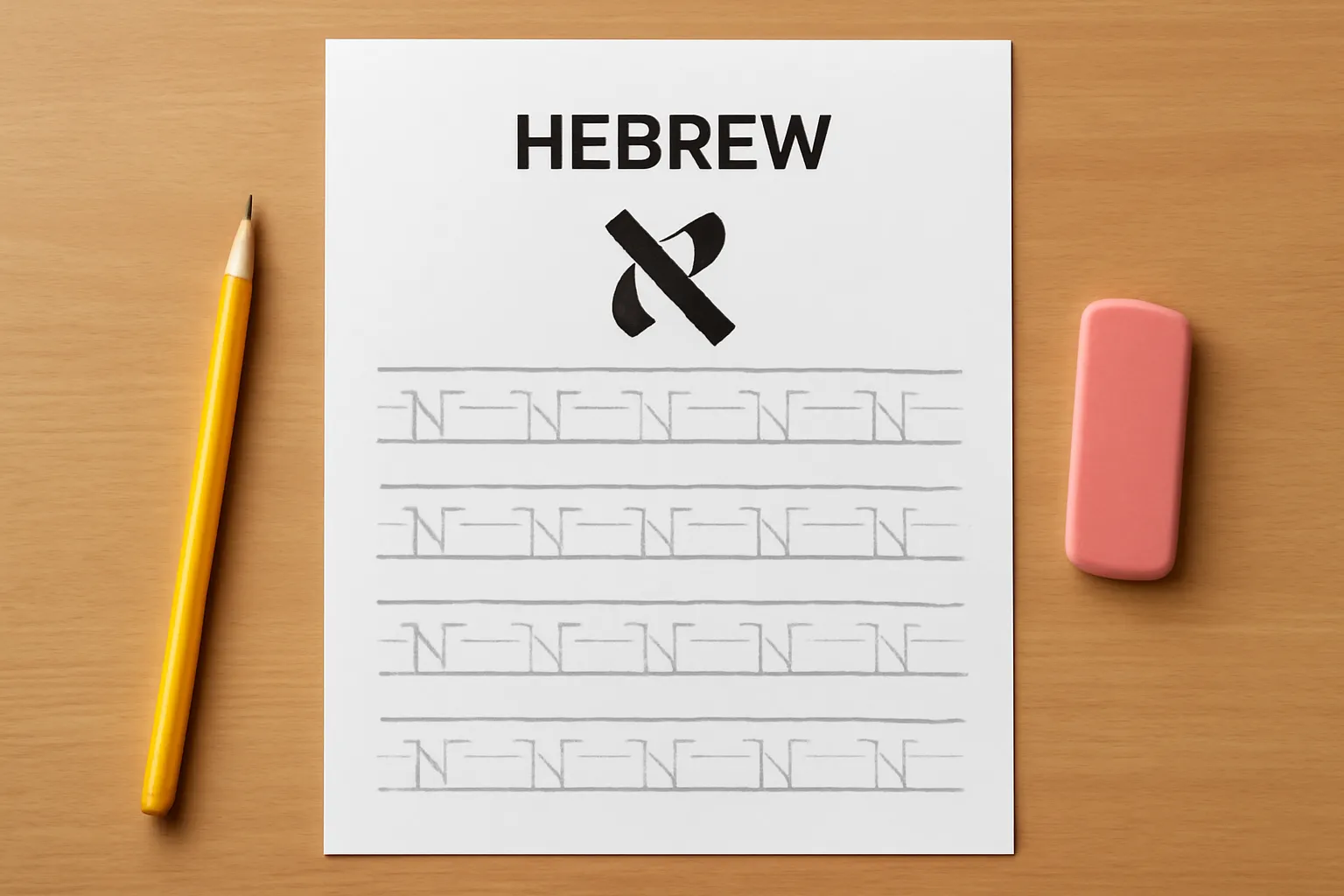
Hebrew Worksheets offer a structured and engaging way to introduce and reinforce the Hebrew script, numerals, and vocabulary for learners of all ages. In this article, we explore the world of free printable Hebrew worksheets that cover the alphabet, numbers, and vocabulary. You will find a range of formats and activities designed to support beginners as well as more advanced students, with plenty of variations to match different learning styles. Whether you are a parent, teacher, tutor, or self-learner, these resources can be used in classrooms, after-school programs, tutoring sessions, or at-home practice.
Structured practice helps learners build familiarity with letter shapes, sounds, and writing order.
Progress tracking is facilitated by printable pages that can be graded or reviewed over time.
Motivation and engagement come from color, puzzles, and themed activities that connect language to real-world contexts.
Accessibility options, such as large-print versions, dyslexia-friendly fonts, or audio-assisted worksheets, support diverse learners.
Parental involvement is easier when parents have ready-to-use activities for home practice.
Free Printable Hebrew Alphabet Worksheets
The Hebrew alphabet consists of 22 letters and has several important features, including final forms for five letters (sofit forms) and traditional right-to-left writing. For beginners, worksheets often emphasize shape recognition, stroke order, and the connection between letters and sounds. For more advanced students, worksheets can introduce nikud (vowel notation) and letter-combinations that appear in everyday Hebrew.
Tracing and Stroke Practice
Tracing worksheets guide learners through the correct stroke order and penmanship for each letter. These pages typically show a dotted outline of a letter that students follow with their finger or a pencil. Variants include:
Single-letter tracing pages with directional arrows to indicate stroke flow.
Progressive traces that increase in complexity, from simple strokes to full letters.
Stroke-order charts that accompany tracing sheets, helping learners remember the proper sequence.
Letter Recognition and Matching
These worksheets focus on identifying Hebrew letters by shape, sound, or position in the alphabet. Variations include:
Match-the-letter activities, where learners pair a letter with its phonetic name or sound.
Picture-to-letter matching, linking a familiar image (e.g., an apple) to the corresponding letter sound.
Flashcards included as printable sheets or as companion digital cards for quick review.
Final Forms and Letter Variations
Some beginner packs introduce the concept of final forms for letters like kaf, mem, nun, pe, and tzadi. Printable resources may offer side-by-side comparisons of normal vs. final shapes, plus color-coding to reinforce differences.
For learners ready to read with vowels, some alphabet worksheets add nikud marks on top of letters. This helps with pronunciation and reading fluency. Other worksheets present consonants only for learners who want to practice decoding without vowel hints.
Free Printable Hebrew Numbers Worksheets
Hebrew numbers can be taught in multiple modes: digits, Hebrew words, or traditional letter-numeric representations. Printable numbers sheets typically cover 1–10 first, then extend to higher values. A variety of formats ensures learners can practice counting, recognizing numerals, and applying numbers in simple math.
Numbers 1–10: Digits, Words, and Symbols
Many numbers worksheets pair each numeral with its Hebrew name (e.g., 1 = אחד, 2 = שתיים) and sometimes with short phrases describing quantity. Variations include:
Counting worksheets: count objects and mark the correct numeral or word.
Word-matching: match the Hebrew number word to its digit.
Dot-to-dot activities that reveal numerals while counting.
Numbers through Graphics and Hands-On Activities
To reinforce numeracy, numbers worksheets often incorporate colorful graphics, such as groups of apples or coins, enabling visual counting. Other engaging formats include:
Color-by-number: learners color sections according to the number or word.
Matching games: pair a Hebrew number word with its corresponding quantity.
Simple arithmetic: addition and subtraction using Hebrew numerals or digits.
Higher Numbers and Simple Gematria Concepts
For more advanced learners, some packs introduce higher numbers and the idea of gematria (assigning numerical values to letters). Printable sheets might present:
Number line practice with Hebrew numerals.
Explorations of number words beyond 10, with practice for reading and writing.
Cross-curricular mini-activities that tie numbers to calendars, dates, or time.
Free Printable Hebrew Vocabulary Worksheets
Building vocabulary is a cornerstone of language learning. Hebrew vocabulary worksheets typically use visuals, context cues, and recall exercises to strengthen memory and usage. These resources can be organized by theme, making it easier to teach practical language for daily life.
Theme-Based Vocabulary Sheets
Thematic packs help learners acquire words related to common topics. Examples include:
Family and people (family members, relations, basic descriptors)
Colors and shapes
Food and drink (fruits, vegetables, dairy, grains)
Animals and habitats
Days of the week and time expressions
School and classroom terms, such as pencils, books, and desks
Picture-to-Word and Matching Activities
Picture-to-word worksheets pair a photo with the correct Hebrew word, encouraging associative learning. Matching activities connect a word to its definition, or to a corresponding image.
Labeling worksheets: students write the Hebrew words under the appropriate pictures.
Label-the-objects: a scene with several items where learners label each item in Hebrew.
Reading and Writing Mini-Activities
Short reading passages tailored to beginning readers often appear in vocabulary packs. Some pages include fill-in-the-blank exercises, while others provide simple cloze sentences to complete with the correct vocabulary word.
To deepen retention, many worksheets incorporate puzzles and games such as:
Word searches in Hebrew;
Crossword-style clues using Hebrew words;
Word scrambles and unscramble challenges;
Memory card games with Hebrew terms and images.
Variations of Hebrew Worksheets by Learning Style
Each learner has a unique style—some benefit from visual cues, others from hands-on practice, and others from auditory support. Here are variations of Hebrew worksheets designed to address diverse needs.
Visual and Kinesthetic Variations
Color-by-letter worksheets that use colors to differentiate letters and sounds.
Trace-and-draw activities where learners trace a letter and then draw a related picture.
Cut-and-paste activities that involve building words from letter tiles or cut-out pieces.
Digital and Printable Hybrids
Some resources offer both printable PDFs and interactive online versions. Digital sheets may include features like electronic tracing with a finger or stylus, audio pronunciation, and auto-check feedback.
Assessments and Progression
Teachers and parents can use packs with built-in assessment prompts: simple rubrics, checklists, and milestone markers to determine when a learner is ready to advance to more complex tasks.
Start with a small, consistent routine—5 to 15 minutes of practice per day. Clearly define goals for each session, such as “recognize ten letters,” “trace all letters in the week,” or “read a two-sentence Hebrew passage.”
Typography and Readability
Choose fonts that are easy to read and appropriate for the learner’s level. For beginners, consider larger letterforms and high-contrast ink. If you print in color, use distinct color-coding for phonetic sounds or vowel marks (nikud) to reduce confusion.
Incorporate Rotations and Routines
Rotate among tracing, recognition, writing, and comprehension activities to maintain engagement. A typical week might include two alphabet sheets, two numbers sheets, and two vocabulary sheets, along with one mixed-activity sheet that combines elements from all three categories.
Differentiation and Accessibility
Offer accommodations such as larger printable pages, fewer items per page, or alternative formats for learners who benefit from multisensory input (e.g., using physical letter tiles or tactile materials).
Printing, Accessibility, and Practical Considerations
When preparing free printable Hebrew worksheets, you should consider printing settings, paper quality, and accessibility features to ensure the best learning experience.
Printing Tips
Print at high resolution to keep letter forms crisp and legible.
Use bold headings and larger margins to prevent crowding on the page.
Choose a font that supports full Hebrew character set and vowels if included (nikud).
Print in color when possible for color-coded categories or illustration cues, but provide a grayscale version for cost-conscious printing.
Offer large-print versions for learners with visual challenges.
Provide audio guidance or links to pronunciation guides to support auditory learners.
Ensure high-contrast designs to enhance visibility for learners with low vision.
Label images with alt-text when used in digital formats for screen readers.
Organizing Printable Resources
Create a simple folder system on your computer or cloud storage (e.g., Alphabet, Numbers, Vocabulary, Themed Sets). Keep a consistent naming convention, such as «Hebrew_Alphabet_Tracing.pdf» or «Hebrew_Vocabulary_Food.pdf,» to make it easy to locate resources when planning lessons.
Where to Find Free Printable Hebrew Worksheets
There are many reputable sources offering free printable Hebrew worksheets. When searching, look for materials that are clearly labeled with their level (beginner, elementary, intermediate), include instructions, and provide answer keys or teacher notes where appropriate.
Hebrew worksheets for the alphabet, numbers, and vocabulary form a versatile toolkit for language learners. The free printable resources described here come in a wide range of formats and themes, enabling teachers and parents to tailor practice to individual needs. From tracing and color-by-letter activities to word searches and cut-and-paste tasks, there is a wealth of options to keep learners motivated and progressing.
As you integrate these worksheets into your study plan, consider pairing them with listening and speaking activities to reinforce pronunciation and conversational use. For example, after practicing the alphabet, learners can recite the sequence aloud, associate each letter with a familiar word, or form simple Hebrew phrases using the letters they have learned. Regular practice, clear goals, and varied formats will help make Hebrew literacy accessible and enjoyable for a broad audience.