Overview: God Wrestling with Jacob as a Transformation Narrative
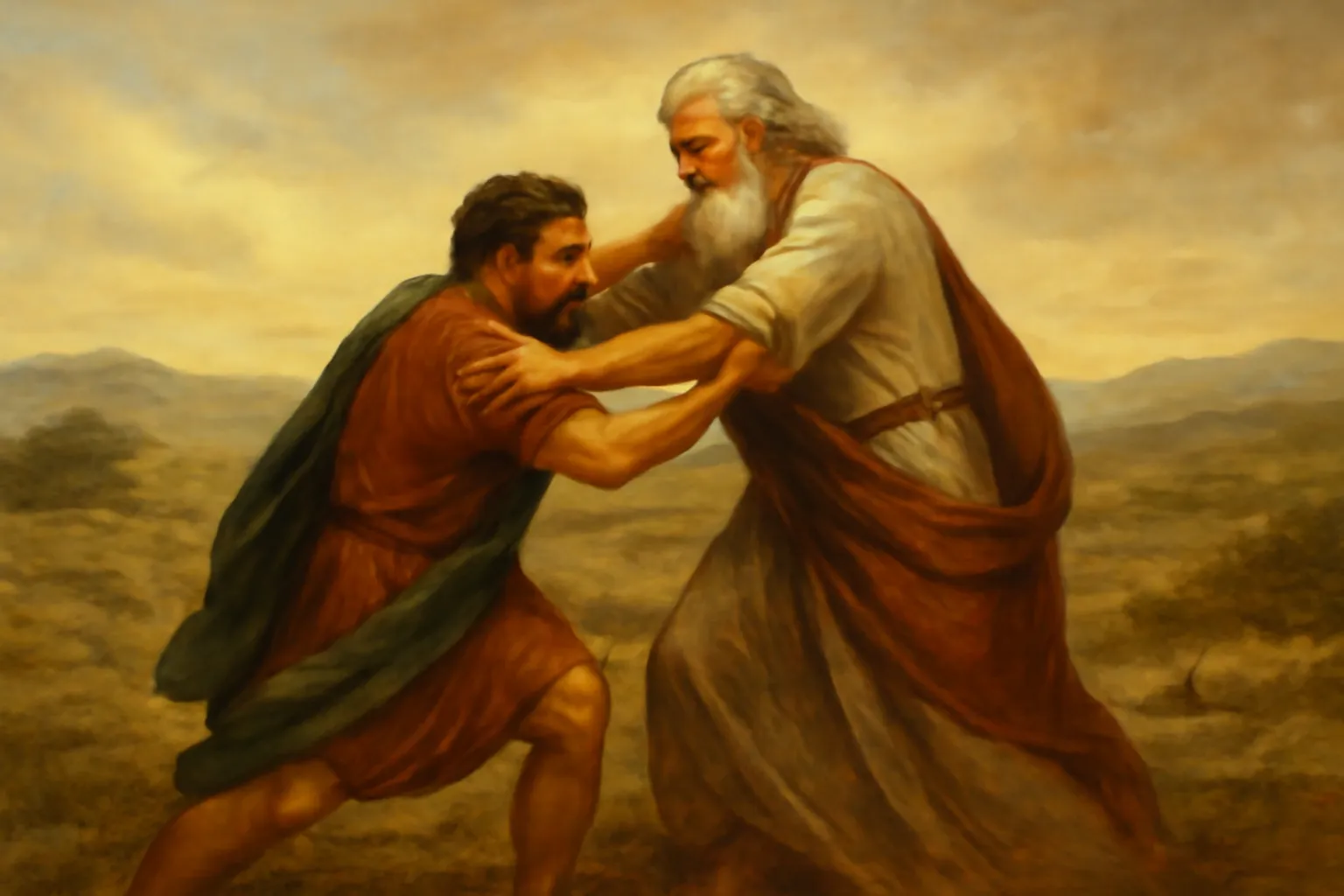
In the biblical narrative, few scenes are as striking as the moment when God wrestles with Jacob.
The late-night struggle, the hidden questions, and the final blessing together form a compact biography of
transformation. This article treats that encounter not merely as a dramatic story, but as a Bible study on transformation—a
text that invites readers to reflect on how struggle with the divine can reframe identity, redirect purpose, and
reconfigure relationships with others and with God Himself.
The account is found in Genesis 32, within the larger arc of Jacob’s life. It sits at a crossroads: Jacob is on the doorstep of a
long-awaited homeland, but he also carries fear—fear of Esau, fear of the future, and fear of meeting God on Jacob’s own
terms. The encounter that follows becomes a mnemonic for spiritual formation: a night of wrestling that ends with a new name,
a new blessing, and a new way of walking through life. Throughout this study, we will use several variations of the phrase
“God wrestles with Jacob” to illuminate different angles of the text: from the divine wrestling to the human wrestling, from the
theophany to the blessing, and from the limping walk to the restored sense of purpose.
Setting the Stage: The Context for the Night-time Encounter
Before the night of struggle, Jacob’s life has already been marked by clever schemes, family drama, and a long migration from
birth to blessing. He has left his homeland to escape his uncle Laban, acquired wealth through labor, and learned painful lessons
about deception and trust. Now, as he returns toward Canaan, he faces a different kind of
uncertainty: the future with his brother Esau. The air is thick with anticipation, and Jacob divides his caravan in part as a
precautionary measure—a reasonable plan given a fragile moment in a fragile relationship.
The night becomes a threshold. Jacob is alone after sending his wives and children ahead, a deliberate moment to seek
divine guidance or at least a personal reckoning. Then, in the dark, a figure appears—an unnamed adversary and yet a figure of
blessing. The story emphasizes that the encounter is not a casual meeting but a deliberate, intention-filled confrontation that
will leave both parties forever altered. The night-long struggle is about more than strength; it is about who
Jacob will become when his self-sufficiency is tested and his stubbornness is challenged.
The Encounter: Who Wrestles?
The text describes a mysterious wrestler who grapples with Jacob until daybreak. Who is this opponent? The story is
intentionally ambiguous about identity, inviting readers into interpretive discernment. Several traditional readings appear:
Theophany or divine manifestation: many Christian interpreters view the figure as a direct
manifestation of God presenting Himself in a way that Jacob can encounter, wrestle with, and ultimately receive a blessing from.
Angel or a celestial messenger: in Jewish and some Christian traditions, the wrestler is understood as a powerful
angel who acts with God’s authority, delivering a message and testing the heart of Jacob.
A figure of God and man in a liminal form: the text’s ambiguity challenges readers to see this as a moment where heaven and earth
intersect, where the divine presence becomes tangible in a way that changes the human agent forever.
The encounter also raises a significant literary point: Jacob’s opponent does not rush toward a simple negotiation or a decisive
victory in the conventional sense. Instead, the struggle becomes a disciplined dialogue—a test of endurance, a demand for
vulnerability, and a channel for spiritual formation. The wrestling goes on “until daybreak,” a metaphor for a prolonged
process of transformation that cannot be hurried or forced.
Key moments in the encounter
The wrestler notices Jacob’s resolve and does not yield—an indication that this is not mere human combat but a
contest with the purpose of shaping the other’s life.
The divine opponent touches the hip socket, dislocating Jacob’s hip, yet Jacob clings on, refusing to let go.
Jacob’s request for blessing coalesces with a deeper longing: to be named and to be redefined by a divine purpose.
With the blessing finally granted, the opponent grants a name change—an entirely new identity meant to accompany a new
vocation.
One lingering question in this section concerns the precise nature of the blessing. It is not a simple material windfall; rather,
the blessing is a redefinition of who Jacob is and what his life will signify. The term change from Jacob to Israel
marks a turning point: a people-tied identity that will define a nation and shape generations to come.
In the broader arc of biblical theology, the phrase “wrestling with God” in this encounter becomes a shorthand
for a crucial form of spiritual formation: willingness to engage God honestly, even in pain, and to persist until the divine
purpose is revealed. This is not a triumphalist victory but a paradoxical blessing that comes through vulnerability and
dependence.
Transformation Through Struggle: The Turning Point
The turning point of this narrative is not simply the moment of naming or the releasing of a blessing. It is the entire arc of transformation that emerges from the night-long encounter. Jacob’s experience shifts him from a posture of
relying on cunning to a posture of depending on God. The physical sign of that change—the limp—becomes a permanent,
visible reminder of the inner work God has done:
Limp as a symbol: The dislocated hip results in a lifelong limp, a perpetual reminder that Jacob’s
strength is no longer the source of his security. The limp teaches him to walk differently—more humbly, more dependently.
New identity: The name change to Israel reframes the whole life of the patriarch. “Israel” points to a people who
contend with God in every circumstance and who carry a mission that transcends personal ambition.
New vocation: The transformation reframes Jacob’s role not only as a family patriarch but as the ancestor of a people
called to partner with God in the unfolding drama of salvation history.
Blessing as commissioning: The divine blessing is not a private boon; it is a commission that reshapes Jacob’s future
within the covenant narrative and aligns him with God’s redemptive purposes.
Importantly, the text emphasizes that transformation through struggle is not about erasing difficulty but about reinterpreting it.
The divine encounter reframes pain as the context in which God discloses His purposes. The night of wrestling becomes a
gateway to a transformed life—one marked by a deepened sense of vocation, a humbled self-understanding, and a renewed reliance on
divine guidance.
A useful way to reflect on this turning point is to notice how the narrative connects the private experience of wrestling with God to
public demonstrations of reconciliation and leadership. After walking away with a blessing and a new name, Jacob must navigate a critical
moment with his brother Esau. The transformation that occurs in the night prepares him to face external conflicts with a different
posture: not avoidance or manipulation, but trust, humility, and a willingness to seek reconciliation.
Transformation through struggle: The narrative models the idea that growth often happens in the crucible of hardship and
tension, not in easy victories.
Dependence over self-sufficiency: Jacob’s limp invites readers to depend on God rather than on one’s own schemes.
Vulnerability as strength: Clinging to the divine for blessing requires admitting vulnerability and need.
Identity shaping: A name reflects vocation; God’s renaming of Jacob to Israel reframes his entire future and the future of his descendants.
Blessing as calling: The blessing this night grants is inseparable from a summons to participate in God’s purposes for the world.
Practical implications for readers today
Prayer as wrestling: When people “wrestle with God” in prayer, they are not failing by doubting; they are embracing a form of
spiritual conversation that invites God to shape their desires and plans.
Naming and admitting needs: Just as Jacob names his fear and his needs, readers can benefit from articulating their
own fears, weaknesses, and hopes before God in honest, respectful ways.
Seeking blessing beyond personal gain: The blessing God grants is not merely personal advantage; it often carries a
broader calling—to bless others, serve a community, or participate in God’s mission in the world.
Embracing transformation as ongoing: The transformation is not a one-night event but a lifelong process that aligns a person
with God’s purposes in daily decisions, relationships, and leadership roles.
Literary Reflections: Language, Imagery, and Meaning
The Genesis 32 passage uses vivid imagery to communicate its deepest meanings. Consider the following elements and how they
contribute to the overall message:
Wrestling as a deliberate, sustained engagement rather than a quick contest. This signals that genuine transformation
is often costly and requires persistence.
Night as a time of vulnerability and revelation. Darkness here is not merely a physical condition but a symbol for
interior honesty and reliance on God’s light yet to come.
Touch on the hip: The physical injury symbolizes a lasting shift in ability and self-perception, reminding the person
of dependence rather than independence.
Name and identity: A name is not a cosmetic label; it is a destiny statement—an assignment of purpose that alters
how a person sees himself or herself and how others will see him or her.
Theologically, the scene foregrounds a key motif in Scripture: God’s engagement with a person to redirect that person’s life toward a
larger, communal redemptive plan. The private encounter becomes public in the sense that Jacob’s descendants will form a people—Israel—whose
identity is inseparable from a lifelong contest with God’s will and with the world’s challenges.
For readers today, the imagery invites contemplation: how does one approach God in times of anxiety, how does one plead for
blessing while submitting to God’s timing, and how does one walk forward after such an encounter? The answer is not a triumphant
exultation but a faithful, regular dependence on God—a steady walking after a profound, formative night.
Cross-Text Themes: Connections to the Wider Biblical Narrative
The story of God wrestles with Jacob resonates with similar threads across Scripture. A few notable connections include:
Humility through struggle in other biblical figures who find their strength in weakness, echoing the paradox that true power
often manifests through vulnerability.
Identity and vocation—how God calls ordinary people into extraordinary purposes, and how a name or designation often signals a mission.
Reconciliation as a culminating fruit of transformation. Jacob’s inward change ultimately positions him to pursue healing in his
outward relationships, especially with Esau.
From a theological perspective, the encounter also foreshadows later biblical motifs: a people who wrestle with God and yet persist in faith; a
divine blessing that embodies both grace and responsibility; and a destiny shaped not by luck or craft but by covenantal
relationship with the living God.
Study Tools: How to Use This Passage for a Group or Personal Study
Guided reading prompts
Read Genesis 32:22-32 slowly. Note the sequence: preparation, night encounter, injury, blessing, and naming.
Identify moments where Jacob demonstrates persistence and where he demonstrates vulnerability. How do these moments shape your
understanding of faith?
Reflect on the meaning of the new name Israel. In what ways could a people’s destiny be defined by a relationship with God more than by
individual achievement?
Group discussion questions
Is it possible to encounter God in the midst of fear and uncertainty? Share personal examples or examples from Scripture.
What does the limp symbolize in your own life? How can visible signs of vulnerability become opportunities to trust God more deeply?
How does the idea of blessing function as a commissioning in your own spiritual journey? What might such a blessing require of you in daily life?
Prayer resources for reflection
Prayer of honesty: naming fears, hopes, and needs before God without pretense.
Prayer of reception: opening to God’s blessing and accepting a possible redirection of plans and priorities.
Prayer for reconciliation: seeking peace in relationships that have felt strained, acknowledging human limitations, and asking
for God’s guiding wisdom.
Closing Reflections: Living as People Who Walk with God
The story of God’s wrestle with Jacob, often remembered as a night of struggle, invites readers to envision a life
oriented toward transformation rather than avoidance. For contemporary readers, the essential takeaway is not the idea that
pain itself is good, but that meeting God in the midst of pain can reframe one’s identity and vocation. The event does not erase
Jacob’s flaws or his human frailties; instead, it disciplines him toward a hopeful, forward-looking faith. This perspective can
illuminate how we approach our own moments of surrender: with honesty about our struggles, with perseverance in prayer, and with
readiness to embrace God’s blessing as a calling rather than a consolation.
In that sense, the night-long wrestling is a pedagogy of transformation. It teaches that genuine change often arrives through a
willingness to hold on to God when the way forward is uncertain, to accept a sign that points beyond personal strength, and to
step into a future defined by God’s purposes. The result is a life that bears the mark of a divine encounter—a life that moves
forward as one who has met God and who walks with a new and enduring confidence, even when walking is tinged with a limping reminder
of the encounter.
If you wish to revisit this study in the future, consider tracing the linguistic echoes of wrestling, blessing, and naming in Genesis and
in the broader Pentateuch. Observe how similar patterns recur: a person confronted by God, a new name or mission, and a community
shaped by a transformed identity. In every instance, the underlying message remains strikingly consistent: true change comes through
engagement with the divine, and transformation is inseparable from a life lived in covenantal trust.