Welcome to an in-depth, student-friendly guide to Basic Biblical Hebrew. This article is designed for beginners who want to begin reading the Hebrew Bible with confidence, using the original language as a gateway to biblical textures, nuance, and historical context. You will encounter essential concepts such as the Hebrew alphabet, niqquot (vowel points), binyanim (stems), and practical strategies for deciphering verbs, nouns, and syntax. Throughout, you will see bolded terms to emphasize the core ideas, and you will find a mix of explanations, examples, and practice materials to reinforce learning.
Reading the Hebrew Bible begins with a solid grasp of several foundational ideas. These foundational ideas act as a framework that makes it possible to glean meaning from biblical texts that were composed in different historical periods and reflect a range of literary genres, from narrative to poetry to law. The core elements include the alphabet and script, vowel notation, roots and binyanim, and the definite article and construct state that organize Hebrew nouns and phrases. In this section, you will encounter concise explanations of these building blocks, plus practical tips for approaching the text with a reader’s mindset rather than a memorization-only mindset.
The Hebrew Alphabet and Vowels
The Alphabet (consonants)
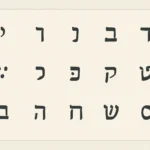
The Hebrew script uses a set of 22 consonants. Some letters have more than one sound, and a few are «gutturals» that influence adjacent vowels. The common group includes the following letters, listed in conventional order:
Alef (א), Bet (ב), Gimel (ג), Dalet (ד),
He (ה), Vav (ו), Zayin (ז), Het (ח),
Tet (ט), Yod (י), Kaf (כ), Lamed (ל),
Mem (מ), Nun (נ), Samekh (ס) or Samekh (ס) in traditional order,
Ayin (ע), Pe (פ), Tzadi (צ), Qof (ק),
Resh (ר), Shin (ש) / Sin (ש with a dot on the right or left), Tav (ת).
Notice that some letters share shapes but differ in pronunciation depending on their position or the presence of a diacritic called a dagesh (a dot placed inside the letter). The two-letter combo שׁ/שׁ (Shin with a dot on the right) and שׂ/שׂ (Sin with a dot on the left) distinguishes two sounds. In modern editions, you may see a mixture of unvocalized text (without vowels) and vocalized text (with niqquot). The Bible, in its traditional Masoretic form, is typically read with vowel points—the niqquot—which indicate vowel sounds and help convey tense and aspect in some verbs.
The niqquot are the systematic points and marks added to consonants to indicate vowels. They are essential for beginners because they show how words are pronounced and where the emphasis lies. For example, consider the famous opening of Genesis: בְּרֵאשִׁית (Bereshit), בָּרָא (bara), אֱלֹהִים (Elohim). You will often see the combination of niqquot with cantillation marks (ta’am) in printed editions. Cantillation marks indicate how sentences flow, where to pause, and how to connect phrases in poetry and narrative. When you are starting out, you can focus on niqquot to build your reading foundation, while gradually learning cantillation as you progress toward more advanced textual understanding.
Modern vs. Biblical pronunciation and practice
There is a distinction between Biblical pronunciation (often reconstructed from Masoretic tradition) and Modern Hebrew pronunciation used in contemporary conversation. For beginners, it is common to study Biblical Hebrew using the traditional vowel system, and then later compare with Modern Hebrew pronunciation when encountering loanwords or poetry that sounds more modern. The most important point is consistency: use the same system as you begin, so your reading remains coherent as you build vocabulary and grammar.
Words, Roots, and Binyanim: The Core of Biblical Hebrew Grammar
What is a root?
A central concept in Biblical Hebrew is the idea of roots. A root is a small set of consonants—usually three, and sometimes two—that carries the core semantic meaning of a word. Most roots are triliteral (three-consonant) or occasionally biliteral (two-consonant) with added vowels and affixes to create related forms. From a given root, you can derive a family of related words by applying different binyanim (stems) and morphological patterns. The process is not just about memorizing forms; it is about recognizing that many related words share a semantic field and behave similarly in conjugation and agreement.
For example, the root כתב (k-t-b) underlies a family of words connected to writing: to write, written, scribe, and so on. Seeing a form such as כָּתַב (katav) signals a basic act of writing, while related forms like מִכְתָּב (mikhtav, «a letter» or «a written document») or כְתָב (ketav, the act of writing) expand the semantic field around the root.
The major stems (binyanim) you will encounter
In Biblical Hebrew, most verbs occur within a binyan or stem. Each binyan changes the meaning of a root and modifies its morphology in a distinct way. Here are the major stems you will encounter, with concise definitions and typical usage. Bold terms indicate the essential concept for quick reference.
Qal — The basic, straightforward, or «simple» stem. It expresses active, in-relation-to-subject meaning. Example: the verb כָּתַב (katav) means «he wrote.» This is the default form you will see when you study new roots.
Niphal — The passive or reflexive stem. It often conveys that the action happened to the subject or was experienced by the subject. Example forms include נִכְתְּב (nikhtav) «it was written» or נִשְׁמַע (nishma) «it was heard» (from שמע, «to hear»).
Piel — A causative or intensive stem. It often intensifies the action or conveys a deliberate, «caused to» sense. Example verbs derived from writing, speaking, or doing can appear in this stem to indicate an intensified action.
Hiphil — A causative or factitive stem. It usually expresses causing someone else to do something or bringing about a state. For instance, a verb built in the Hiphil might mean «to cause to tell,» «to make someone see,» or «to cause to be.»
Hitpael — A reflexive or reciprocal stem. It often indicates actions done to oneself or mutual actions among subjects. Example usage includes expressions like «to prepare oneself» or «to fight with one another,» depending on the root.
Hithpael — A related reflexive/stem family with nuances similar to the Hitpael but formed in specific patterns.
Understanding these stems provides a framework for deciphering many Hebrew verbs in context. While you will not memorize every form at first, recognizing the binyan pattern helps you identify tense, voice, and aspect and makes dictionary lookup more systematic.
Common verb forms and tenses: a practical starting point
In Biblical Hebrew, the main morphological division is between the Perfect (suffix-conjugation) and the Imperfect (prefix-conjugation). A few quick notes:
Perfect (Qal perfect, suffix conjugation) typically expresses completed actions. In narrative passages, you will see many perfect forms in sequence or as historical present, depending on context.
Imperfect (Qal imperfect, prefix conjugation) expresses actions that are not yet completed, ongoing, or repeated; it can convey future actions or conditions in the past, depending on the chain of words and context.
Imperatives are verb forms used to give commands or requests and often appear with a reduced vowel pattern in the second-person forms.
To practice, start with a few familiar roots and observe how different binyanim shape the same root into related meanings. For example, with the root ש-מ-ע (sh-m-ʿ) meaning «to hear,» you can see forms that convey “hear,” “is heard,” “causes to hear,” and “hears (reciprocal or intensifying sense)” depending on the stem and suffixes.
Reading Essentials: Nouns, Definite Article, and Construct State
Gender and number in nouns
Hebrew nouns have grammatical gender: masculine and feminine. They also show singular and plural forms. Adjectives agree with the nouns they describe in gender and number. In addition, nouns can be in the construct state when they form a possessive relationship with a following noun or phrase.
The definite article and the construct state
The definite article ה (ha) is prefixed to a noun to mark definiteness. For example, הַמִּשְׁטָר (ha-mishṭar) means «the decree» where the base form might be מִשְׁטָר (mishṭar). When two nouns are linked in a possessive or descriptive relationship, the first noun is often in the construct state, and the second noun bears the definiteness marker, or the article may apply to the second noun. For example, in Hebrew you say סֵפֶר הַמֶּלֶךְ (Sefer ha-melekh), “the book of the king.” Here the first noun is in construct relation to the second, which carries the definite article.
Common particles and prepositions
In reading the Hebrew Bible, you will encounter many short particles and prepositions that help with syntax and meaning. Key items include:
ו (vav) as a conjunction meaning “and” or sometimes “but,” used to connect clauses. It is often attached to the preceding word as a silent or pronounced prefix.
ב (bet) meaning “in, at, with,” depending on context. It often marks location or instrument.
ל (lamed) meaning “to, for,” or “belonging to” in certain phrases.
כ (kaf) meaning “as” or “like” or used as a comparative prefix in expressions, such as כְּ (ke- or kə- depending on the following letter).
These particles build the scaffolding for syntax and meaning. When you read, annotate the sentence with identifying the particle, the subject, and what role the preposition plays in linking phrases.
Vocabulary and Grammar: Building a Useful Lexicon
Common biblical words and their uses
Below is a concise glossary of words you are likely to encounter early on. Each term is given with a simple sense and a frequent usage note to help you recognize recurring patterns in text.
האמֵץ — a formal, righteous term for “trust” or “believe” in some biblical contexts, often found in covenant language.
אָדָם — “man” or “people,” a foundational noun with masculine gender.
אֵל or אֱלֹהִים — “God” or “gods,” a central term in the biblical text with singular and plural nuances in different contexts.
שָׁלוֹם — “peace” or “completeness,” used frequently in poetry and blessing formulas.
אַרְץ — “land” or “earth”; appears in many places as a geographic or cosmic term.
מֶלֶךְ — “king”; common in historical narratives and prophetic material.
יוֹם — “day”; appears in many phrases and time expressions.
אֵל (El) — “mighty one,” often part of proper names and titles for divine figures.
Learning these words in context—by looking at their roots, stems, and the phrases in which they appear—helps you identify related forms and anticipate grammatical patterns, which makes reading more fluent over time.
Reading Strategies: From Decoding to Understanding
Segmenting and glossing
When you begin reading, practice by segmenting a sentence into plausible units: subject, verb, object, prepositional phrases, and dependent clauses. Add a gloss or short translation after each segment to capture nuance. Over time, your glosses will become sparser as you recognize patterns and vocabulary automatically.
Morphological analysis: clues for verbs and nouns
Key clues to look for include:
Verb forms that indicate person, gender, and number.
Prefixes that mark imperfect tense (future or ongoing action) and suffixes that indicate possessives or direct objects.
The presence of the definite article ha- to identify definite nouns.
The noun’s construct state to understand possessive relationships within noun phrases.
Transliteration and translation practice
Begin by transliterating short phrases you know, then gradually translate them into your native language. This helps you map Hebrew sounds to the meaning and reinforces memory. Eventually, practice direct translation without transliteration to strengthen your ability to read Hebrew text on its own terms.
Sample Passages for Practice: Short Readings with Annotations
Practice Passage 1: Genesis 1:1 (Genesis, Opening)
Begin with the classic opening line. The passage below uses niqquot to help with pronunciation and reading. You can copy this text into a word processor that supports right-to-left direction to study it more comfortably.
Translation: “In the beginning God created the heavens and the earth.”
Annotation tips:
– Identify the subject «אֱלֹהִים» and the finite verb «בָּרָא» (causally tied to the subject).
– Notice the particle אֵת, which marks the direct object of the verb in certain constructions.
– See the pair of הַשָּׁמַיִם and הָאָרֶץ as the two objects of creation, framed by the conjunction וְ־ (and).
Practice Passage 2: A short verse showing construct state and article
הַכֹּהֵןהָיָהאַרְיֵההַמִּסְתַּכֵּל—
Note: The example above is included for practice with nominal phrases involving the definite article and construct-like phrasing. In actual biblical Hebrew, you would encounter full verses with more precise grammar; use this as a scaffold for building familiarity with article usage and noun phrase structure.
Common Pitfalls and Practical Tips for Beginners
Don’t fear the vowels at first
Although niqquot can seem daunting, begin by reading unvocalized text (without vowels) to train word recognition, then gradually reintroduce vowels as you become more confident. The goal is to recognize patterns, not to memorize every vowel permutation at once.
Start with high-frequency verbs and nouns
Concentrate on high-frequency verbs (e.g., “to say,” “to go,” “to be,” “to do,” “to give”) and core nouns (e.g., “God,” “man,” “earth,” “king,” “house”). As you encounter patterns, you will see the same roots and binyanim repeatedly, which reinforces learning.
Use glossing and parallel texts
Glossed editions, side-by-side translations, and lexical aids can be invaluable. Create a personal glossary of roots and binyanim, with short example phrases, to revisit during study sessions. Building a small “toolkit” of frequently encountered forms reduces cognitive load and accelerates reading speed.
Practice with verse-by-verse readings
Read a single verse slowly, analyze its syntax, and annotate the subject, verb, object, and modifiers. Then move to the next verse. This approach helps you retain grammar patterns and improves overall reading fluency.
Grammar handbooks and introductory textbooks on Biblical Hebrew—great for structured explanations of binyanim, verb paradigms, and noun morphology.
Lexicons and concordances—essential for checking root meanings and finding related forms across the Bible.
Interlinear translations—useful for mapping Hebrew words to their English equivalents while learning vocabulary and grammar.
Online courses and video tutorials that demonstrate vocalization, grammar patterns, and reading strategies.
Academic or liturgical cantillation guides that explain the ta’am marks and how they shape phrasing and emphasis.
Building a Strong Foundation: A Quick Reference
Here is a compact, practical checklist you can return to as you study Biblical Hebrew. Each item is a key component of reading practice and semantic comprehension.
Alphabet and diacritics: Learn the 22 consonants and the common vowel signs (niqquot). Understand a few basic cantillation concepts to aid rhythm and phrasing.
Root and binyan intuition: Practice identifying triliteral roots and recognizing the major stems (Qal, Niphal, Piel, Hiphil, Hitpael).
Noun morphology: Understand gender, number, the definite article, and the construct state for possessive phrases.
Verb morphology: Begin with the perfect and imperfect forms in the Qal, then observe how other stems alter meaning.
Syntax awareness: Learn to identify subject-verb agreement, prepositional phrases, and clause boundaries.
Practice readings: Work with short verses, gradually increasing length and complexity as confidence grows.
Glossing habit: Keep a personal glossary of roots, stems, and common words for quick reference.
Contextual understanding: Read with an eye toward historical and literary context to interpret nuance faithfully.
Further Thoughts on Semantic Breadth: Variations of Basic Biblical Hebrew
To deepen your understanding, it helps to explore variations of basic biblical Hebrew usage across different textual domains. You will encounter changes in vocabulary, syntax, and stylistic devices depending on whether you study narrative prose, prophetic poetry, wisdom literature, or legal material. Here are a few notes on semantic breadth:
Narrative prose often uses a sequence of Qal perfect forms and a linear flow of events. Verbal forms may be used in a way that foregrounds action and causality.
Prophetic poetry frequently relies on parallelism, imagery, and intentional rhythm. You will see more imperfect forms in some contexts to convey prospective or propulsive action, along with heightened diction.
Wisdom literature may emphasize causality, moral causes, and proverbial patterns. Expect a broad spectrum of hendiaducts and paired phrases to convey nuanced meaning.
Legal material tends to foreground obligations, commands, and ritual actions. You will encounter imperative forms, repeated refrains, and formulaic language associated with covenantal law.
By recognizing these contextual patterns, you will gain a more flexible and nuanced approach to basic biblical Hebrew, enabling you to parse sentences not only by grammar but also by literary function and theological intention.
Glossary of Bold Terms (for Quick Reference)
Below is a concise list of bold terms you may have encountered in this article, with brief reminders of what they mean. This is designed to be a quick reference while you study.
Hebrew alphabet — the set of 22 consonants used to write Biblical Hebrew.
niqquot — vowel points used to indicate pronunciation in letters and words.
cantillation (ta’am) — marks indicating singing rhythm and syntactic grouping in biblical text.
binyan — a verbal stem pattern or «binah» that modifies a root’s meaning (e.g., Qal, Niphal, Piel, Hiphil).
root — a small cluster of consonants conveying the core meaning of a word.
construct state — a grammatical relationship in which the first noun modifies the second noun to express possession.
definite article — the prefix ה (ha) marking definiteness.
perfect and imperfect — two fundamental verb forms expressing completed action vs. ongoing or future action, depending on context.
subject-verb agreement — the alignment of gender and number between subject and verb in Biblical Hebrew.
Closing Thoughts: Your Path to Proficient Biblical Hebrew Reading
Learning to read the Hebrew Bible is a journey that blends memory, analysis, and exposure. It requires patience, practice, and regular engagement with authentic texts. By grounding yourself in the alphabet and vowels, embracing the underlying root and binyanim, and applying consistent reading strategies, you will steadily unlock the textures and meanings embedded in biblical prose and poetry. Remember to balance mechanical study with interpretive reading: ask what the phrase means in its local context, how the syntax shapes interpretation, and how the words relate to the larger themes of the book you are reading.
As you progress, you can expand your practice by working with parallel texts, building a personalized dictionary of roots and common stems, and gradually tackling longer passages. The Hebrew Bible rewards careful, well-paced study, and the rewards include a deeper sense of the language’s rhythm, imagery, and covenantal language that has shaped religious thought for millennia.