Welcome to a practical, beginner-friendly introduction to Hebrew. Whether you’re planning a trip, reconnecting with family, studying Jewish texts, or simply exploring a new language, this guide is designed to give you a solid foothold in Modern Hebrew (the form most people use in Israel today) while also touching on Biblical Hebrew as a historical context. You’ll find clear explanations, actionable steps, and a variety of exercises that you can apply right away. The goal is to help you gain confidence quickly while building a foundation you can expand over time.
You’ll understand the Hebrew alphabet (the Alef-Bet), how to read simple words, and how to recognize common consonant sounds.
You’ll get a handle on basic pronunciation and the role of vowels (the niqqud and related systems).
You’ll master core grammar essentials for everyday communication, including gender, articles, and basic verb forms.
You’ll learn everyday phrases for greetings, questions, directions, shopping, and more, with practical examples and variations.
You’ll discover effective learning strategies and a starter study plan that fits a busy schedule.
Hebrew: a language family with two main branches
Hebrew today exists mainly in two forms that beginners encounter most often. It’s useful to recognize the distinction early so you can tailor your study to your goals.
Modern Hebrew (Israeli Hebrew)
Modern Hebrew, or Israeli Hebrew, is the standard form used in daily life in Israel, education, media, and most contemporary literature. It is a living language with a straightforward grammar and a large vocabulary drawn from both native roots and loanwords. For beginners, Modern Hebrew offers a clear path to practical communication—speaking, listening, reading, and writing simple sentences, ordering in a cafe, asking for directions, or describing your day.
Biblical Hebrew
There is also Biblical Hebrew, the form found in the Hebrew Bible. It differs in pronunciation traditions (historical and liturgical), vocabulary, and grammar from Modern Hebrew. Some learners study Biblical Hebrew to access ancient texts, study religious studies, or gain a deeper sense of the language’s history. While Biblical Hebrew can inform your understanding of Modern Hebrew, most beginners start with Modern Hebrew and branch into Biblical Hebrew later if their goals require it.
The Hebrew alphabet: letters, script, and orientation
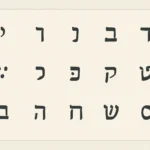
The Alef-Bet (the Hebrew alphabet) comprises 22 consonants written from right to left. In everyday writing, vowels are typically not written as full letters, especially in everyday signage, newspapers, and most printed materials. When you learn as a beginner, you’ll encounter both the consonants alone and the consonant-vowel system called niqqud (the vowel points). Here are the essentials you should know to get started.
The basics of the Alef-Bet
There are 22 consonants in the standard alphabet, with five letters that have a special final form when they appear at the end of a word: ה (hei), ו (vav), כ/ך (kaf/kaf sofit), מ/ם (mem/mem sofit), נ/ן (nun/nun sofit).
Hebrew is written and read from right to left.
Some letters have different sounds depending on their position or surrounding vowels. For example, ב can be /b/ or /v/ depending on whether it has a dagesh (the dot in the middle) in older printings, though in everyday Modern Hebrew you’ll typically hear /b/ in most contexts.
Many learners start by recognizing the basic consonant sounds and then gradually learn the final forms and occasional pronunciation exceptions.
Vowels and the niqqud system
In printed Modern Hebrew for everyday readers, vowels are often omitted. When they are included, they appear as dots and dashes above or below the consonants and are called niqqud. They help non-native speakers pronounce unfamiliar words accurately. Some common niqqud marks you may encounter are:
Chirik – a small dot under the letter for the /i/ sound (as in “machine”).
Patach – an open horizontal line under the letter for the /a/ sound.
Kamatz – a small T-shaped mark under the letter for a long /a/ sound that’s similar to /a/ in “father.”
Segol – three dots under the letter for /e/.
Shva – a very light or silent vowel mark, often not pronounced.
As a beginner, you’ll often learn with niqqud in textbooks or language courses to anchor pronunciation. As you gain confidence, you’ll read more without niqqud and rely on context, familiarity, and intonation to guide you.
Pronunciation tips for beginners
Getting a feel for Hebrew sounds early on will make a big difference in your progress. Here are practical tips to start with:
Emphasize the consonants first. Hebrew has several consonants without direct English equivalents, such as כ/ך (k or kh), ח (ḥ, a voiceless pharyngeal fricative-like sound), and צ (ts). Don’t worry if you can’t master all of them immediately; focus on the most common ones first.
Practice the soft vowels in short phrases. In Modern Hebrew, vowels are less pronounced in casual speech, but accurate pronunciation will help you be understood in real-life settings.
Listen and imitate. Use dialogues, short podcasts for beginners, or language apps that provide native speaker audio. Repeat until you can match the rhythm and melody of everyday speech.
Work on stress. Hebrew words typically place the stress on the penultimate syllable (the second-to-last). Some words differ, so when in doubt, listen to native speakers or ask a teacher for guidance.
Grammar foundations for beginners
Grammar is the backbone of any language. In Hebrew, you’ll find some features that are especially important for beginners:
Nouns, gender, and number
Hebrew nouns have grammatical gender: masculine and feminine. This gender affects accompanying articles, adjectives, and verbs in some tenses.
The definite article is ה (pronounced “ha-”) and is prefixed to the noun. For example, בית (bayit) means “house,” while הבית (ha-bayit) means “the house.”
Plural forms often involve changes to the word’s ending and sometimes the vowel pattern. For beginners, the most common patterns are revealed through vocabulary lists and example phrases.
Definite article and construct state
The definite article ה attaches to a noun directly, as shown above. In some cases, when two nouns are used together in a construct phrase (like “bookstore” or “teacher’s book”), you’re dealing with the construct state, where the first noun modifies the second. This is a regular feature across Hebrew, and practice with phrases will make it feel natural.
Basic verb forms and present tense
Hebrew verbs are organized into binyanim (stems) that convey aspects of meaning such as action, reflexivity, or causation. For beginners, the Pa’al (simple active) pattern is the most common for everyday verbs in the present and past tenses.
In present tense, Hebrew uses a form that agrees with the gender and number of the subject. For example, אני לומד (ani lomed) means “I study” (masculine), while אני לומדת (ani lomedet) would be “I study” (feminine).
Past and future tenses exist, but beginners often start with simple present-tense phrases for everyday communication and gradually add past and future as they grow more comfortable.
Common phrases and practical dialogues for beginners
Building a practical vocabulary of everyday phrases is essential for confidence. Below are common categories with sample sentences in Modern Hebrew, plus variations you may hear in different contexts.
Daily practice (even 15–20 minutes) beats long, irregular sessions. Consistency is key.
Use flashcards for vocabulary with spaced repetition. Include gender notes and example sentences.
Incorporate listening and speaking early. Short audio clips, dialogues, and role-plays accelerate retention.
Create a habit of reading aloud. Start with simple sentences and gradually add complexity.
Keep a Notebook of phrases you actually use. Personal phrases will be easier to memorize.
When reading, connect each word to a meaning, a sound, and a context. This reinforces memory.
Learning resources and recommended materials
A mix of formats helps you stay engaged. Here are recommended resources for beginners, with options for self-study, guided courses, and in-person practice.
Textbooks and workbooks that are designed for beginners and include audio components.
Language apps like Duolingo, Memrise, or Rosetta Stone for daily practice and vocabulary drills.
Online courses with structured modules, exercises, and feedback from instructors (e.g., HebrewPod101, Hebrew courses on platforms like Coursera or Udemy).
Audio resources such as beginner podcasts or children’s programs in Hebrew to build listening comprehension.
Conversational partners—language exchange meetups, tutors, or language-buddy apps to practice speaking.
Children’s books and simple news articles to see vocabulary in context and gradually introduce more complex sentences.
Practical tips for beginners: building confidence fast
These practical tips help you stay motivated and progressively improve your skills:
Set small, concrete goals each week (for example, learn 20 new words, master five phrases, or write a short paragraph about your day).
Label items in your home with their Hebrew names to reinforce everyday vocabulary.
Use Hebrew in real-life situations whenever possible (ordering food, asking for directions, greeting neighbors).
Record yourself speaking and compare it with native pronunciation. Adjust tone and rhythm as you listen back.
Seek feedback from tutors or native speakers. Constructive feedback is essential for rapid improvement.
Every language has its tricky parts. Here are some typical beginner challenges in Hebrew and practical ways to address them.
Gender and agreement: nouns, adjectives, and verbs can reflect gender and number. Practice with paired vocabulary and example sentences to internalize patterns rather than memorize exceptions.
Pronunciation of certain consonants: sounds like /ħ/ or /ʔ/ can be unfamiliar. Start with familiar words, and gradually introduce minimal pairs to sharpen your ear.
Reading without vowels: when niqqud is absent, use context and your growing vocabulary to infer pronunciation. Don’t be discouraged—this is normal in everyday Hebrew texts.
Verb tenses: Modern Hebrew often uses present tense where other languages might use a different form. Focus on the Pa’al pattern first and expand to past/future as you gain confidence.
Listening pace: native speech can sound fast. Begin with slowed-down audio, then gradually increase difficulty as your listening comprehension improves.
A simple four-week starter plan for busy learners
If you’re aiming for a practical ramp-up, try this four-week plan. It’s designed to fit into a tight schedule while delivering meaningful progress.
Week 1: Learn the 22 consonants and the basic right-to-left writing direction. Practice the Alef-Bet with simple flashcards. Start with 20 essential words (greetings, basics, numbers). Short daily listening exercises (5–10 minutes) to hear how Modern Hebrew sounds in context.
Week 2: Introduce niqqud basics and practice pronunciation with 10–15 short phrases. Learn essential grammar concepts: the definite article ה, gender distinctions, and simple subject-verb agreement in present tense (Pa’al pattern). Begin a small vocabulary set focused on everyday needs: food, family, directions, time.
Week 3: Start forming simple sentences. Create a personal diary entry in Hebrew (a few lines) about your day or plans for the weekend. Add two new verbs in the Pa’al family and practice present-tense conjugation with a partner or tutor. Engage with 15–20 minutes of listening to beginner dialogues or children’s programs.
Week 4: Practice short conversations and role-play scenarios (ordering at a restaurant, asking for directions, introducing yourself). Expand your vocabulary by 25 more words and review all learned material. Plan ongoing study: a habit, weekly goals, and a list of resources to keep growing beyond the first month.
Sample mini-dialogues for practice
Use these short exchanges to practice pronunciation, rhythm, and everyday vocabulary. Try saying them aloud with a partner or recording yourself.
Person A: שלום, מה שמך?Shalom, ma shimcha? (Hello, what is your name?)
Person B: שלום. קוראים לי [Name].Shalom. Kor’im li [Name]. (Hello. My name is [Name].)
Person A: נעים מאוד!Nimra meod! (Nice to meet you!)
Person A: היכן השירותים?Hakhan ha-sherutim? (Where are the restrooms?)
Person B: הנה, ליד המטבח.Hineh, le-ed ha-mitbah. (Over there, next to the kitchen.)
Variations of beginner Hebrew to broaden your understanding
To deepen your comprehension and ensure you’re not limited to a single form, explore these variations and angles. They help you think in Hebrew from different perspectives and prepare you for a broader set of contexts.
Colloquial Modern Hebrew: Focus on slang, everyday expressions, and natural speech patterns you’ll hear in Israel.
Formal Hebrew: Learn registers used in official discourse, news, and formal writing materials.
Israeli culture-informed Hebrew: Integrate cultural terms, holidays, and social phrases that enrich your conversational abilities.
Hebrew for travelers: Emphasize essential phrases for airports, hotels, transportation, menus, and sightseeing.
Hebrew for reading practice: Include simple Hebrew children’s stories, comics, or news articles, so you encounter everyday vocabulary in context.
Quick-start checklist for beginners
Learn the Alef-Bet and practice reading right-to-left.
Master a core set of daily-use phrases (greetings, polite expressions, common questions).
Understand gender and the definite article to form basic phrases.
Practice present tense verbs and simple sentence structures.
Engage with listening and speaking regularly to build pronunciation and confidence.
Use a mix of text, audio, and conversation to reinforce learning and maintain motivation.
Common mistakes beginners make and how to avoid them
Every learner encounters missteps. Here are some frequent issues and practical ways to address them:
Overemphasizing spelling over pronunciation. Practical tip: prioritize sounding words correctly in conversations, then cross-check with spelling later.
Relying too much on transliteration. Try to link words directly to Hebrew sounds rather than converting them into English equivalents.
Trying to translate word-for-word. Hebrew sentence structure often differs from English. Focus on natural phrase order and meaning rather than direct translations.
Neglecting listening practice. Include short audio sessions daily, even if it’s just a few sentences from a podcast or a dialogue in a textbook.
Skipping review. Revisit vocabulary several times with spaced repetition to transfer items from short-term to long-term memory.
Closing thoughts: building a sustainable learning habit
Starting Hebrew as a beginner is a rewarding journey. The most important ingredients are consistency, practical exposure, and a willingness to practice speaking even when you feel unsure. By focusing on the alphabet, the pronunciation, and the simple grammar, you’ll begin to form meaningful conversations in a relatively short period. As you gain confidence, you can expand to more complex sentences, richer vocabulary, and broader cultural contexts. Remember that every word you learn brings you closer to understanding a vibrant culture and a living language.
Final note: embracing variations and maintaining momentum
One of the most helpful aspects of learning Hebrew is recognizing that there isn’t a single “correct” way to say everything. You’ll encounter modern usage in day-to-day life, biblical sentiments in religious study, and occasional regional or familial variants in spoken language. Embrace these variations as part of your learning journey. They will deepen your comprehension, broaden your vocabulary, and increase your ability to communicate effectively in a wide range of situations.