Hebrew Calendar Day: A Beginner’s Guide to Jewish Dates
The Hebrew calendar day is more than a date on a page. It is a system that combines lunar months with solar adjustments to create a structure that governs holidays, religious observances, and daily life in Jewish communities around the world. For many readers, learning to read a Jewish calendar date or a Hebrew date can seem intimidating at first. This guide aims to demystify the topic, explain how the calendar works, and provide practical tips for recognizing and interpreting Hebrew calendar days in everyday life.
What is the Hebrew calendar?
The Hebrew calendar is a lunisolar calendar, meaning it tracks both the Moon’s phases and the Sun’s seasonal cycle. This dual nature ensures that months stay aligned with the lunar cycle while seasons remain in their expected positions year after year. The calendar is used primarily for determining the dates of Jewish holidays, festivals, fast days, and Sabbaths. It is distinct from the civil Gregorian calendar in that a date like “15 Nisan 5785” has inherent religious significance and a fixed placement within a yearly cycle.
Key concepts to know
Lunisolar system: months are lunar, but the year is adjusted to keep holidays in their proper seasons.
Year numbering in the Hebrew calendar uses the count from Creation, which currently places the year in the 5700s range (for example, 5784 or 5785).
Months are named and ordered, with special adjustments in leap years (Adar I and Adar II).
Holidays and ordinary days are counted together in the same system, so many religious observances occur on specific Hebrew dates.
Structure of the year: months, days, and leap years
Understanding the structure of the year helps to read any Jewish date. The year is composed of a sequence of months and a yearly cycle that sometimes adds an extra month during leap years. Here are the essentials:
Months in the year
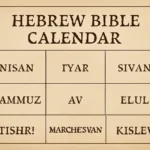
The Hebrew calendar uses a fixed set of month names in a specific order. In a standard (non-leap) year, there are 12 months. In a leap year, there are 13 months. The months, in order, are:
Nisan
Iyar
Sivan
Tammuz
Av
Elul
Tishrei
Cheshvan
Kislev
Tevet
Shevat
Adar (common year) or Adar I / Adar II (leap year)
In a leap year, Adar is split into two months: Adar I (larger, 30 days) and Adar II (smaller, 29 days). In a common year, there is a single Adar month, typically 29 days long. The months Cheshvan and Kislev can vary in length from year to year to produce the correct total days for the year.
Year lengths and the leap cycle
The Hebrew calendar follows a 19-year cycle known as the Metonic cycle. In this cycle, seven leap years occur. The leap years typically fall in years 3, 6, 8, 11, 14, 17, and 19 of the cycle. During those leap years, an extra month (Adar I) is added to the calendar to keep the lunar months in sync with the solar year. The total length of a year can be one of three common lengths and one of three leap lengths:
Common year lengths: 353, 354, or 355 days.
Leap year lengths: 383, 384, or 385 days.
The lengths of Cheshvan and Kislev are adjusted to ensure the year ends on the correct day of the week and that the calendar remains aligned with the seasons. This flexibility is a central feature of keeping a robust Hebrew calendar day structure year after year.
A typical Hebrew date appears as a day number followed by a month name and finally the year in Hebrew numerals. In everyday English-language materials, you may also see it rendered as day-month-year with transliteration, such as “15 Nisan 5784.” The day and month are the most important components for the calendar day you need to observe or track.
How to interpret a date on the page
Day: A number from 1 to 30, depending on the month. Some months have 29 days, others have 30.
Month: One of the twelve (or thirteen in a leap year) named months listed above. The month border signals a transition to a new calendar day.
Year: A four-digit Hebrew year such as 5784 or 5785. The year indicates the cycle within the long religious count and helps determine the timing of holidays and mitzvot for that year.
Because the Hebrew day begins at sunset rather than at midnight, a date can start in the evening of one Gregorian day and continue into the next. This is essential when planning events or reading a calendar for the upcoming week.
Examples of common dates and what they signify
1 Tishrei 5785: The start of the civil and religious year, known as Rosh Hashanah, the Jewish New Year.
10 Tishrei 5785: Yom Kippur, the Day of Atonement, a major fast and solemn fast day.
15 Kislev 5785: The middle of Hanukkah, a festival of lights lasting eight days.
Note that the same Hebrew date can correspond to different Gregorian dates from year to year, because the lunar-solar cycle does not align perfectly with the solar year. For this reason, many people rely on published calendars or digital tools to convert between the two systems.
Important holidays and their typical dates in the Hebrew calendar
Many readers are especially curious about the relationship between the Hebrew calendar day and annual religious observances. While the exact Gregorian dates of holidays shift from year to year, their Hebrew calendar dates stay consistent (for example, Rosh Hashanah is always on 1 Tishrei). Here are some key holidays and the Hebrew dates when they occur most commonly.
Major festivals by date
Rosh Hashanah — 1 Tishrei (beginning of the year)
Yom Kippur — 10 Tishrei (Day of Atonement)
Sukkot — 15 Tishrei (beginning of the week-long festival)
Simchat Torah — 23 or 24 Tishrei (end of the festival cycle, depending on the year)
Hanukkah — Kislev 25 to Tevet 2 (eight days, typically late December to early January in the Gregorian calendar)
Purim — 14 Adar (or 14 Adar II in leap years in the diaspora; Jerusalem and other walled cities celebrate on 15 Adar)
Passover (Pesach) — begins on 15 Nisan (first day of the festival in many communities)
Shavuot — 6 Sivan (one or two days, depending on community and location)
These examples illustrate how a Jewish date on the calendar anchors both religious rituals and communal life. The exact Gregorian dates shift each year, but the Hebrew dates themselves remain consistent within the calendar system.
Practice tips for remembering holidays by date
Keep a personal calendar that marks Hebrew dates alongside Gregorian dates for the same day.
Learn a few anchor dates (for example, 1 Tishrei for Rosh Hashanah and 15 Nisan for Passover) to anchor the calendar in your memory.
Use online converters or mobile apps to translate between Hebrew calendar days and Gregorian dates for planning.
Common questions about the Hebrew calendar day
Why does the Hebrew calendar day begin at sunset?
Traditionally, Jewish days begin at sunset in accordance with biblical timekeeping and rabbinic interpretation. This means that a date may commence in the evening and continue through the next day. When planning meals, prayers, or ceremonies tied to a particular Hebrew date, account for the fact that the day’s observances begin at sundown on the preceding calendar evening.
What is the Lo ADU Rosh rule?
A well-known constraint in the Hebrew calendar is the rule that Rosh Hashanah cannot fall on particular days of the week. Specifically, the acronym ADU corresponds to the days Sunday (Yom Rishon), Tuesday (Yom Sheni), and Thursday (Yom Chamishi) in Hebrew. The rule is often stated as: Lo ADU Rosh — Rosh Hashanah cannot occur on Sunday, Wednesday, or Friday. This ensures that certain holidays avoid problematic calendar alignments and that the calendar year remains in proper alignment with the weekly cycle.
The presence of Adar II in leap years shifts some dates and preserves the seasonal balance. For example, Purim is celebrated on 14 Adar in non-leap years, but in leap years the primary celebration occurs on 14 Adar II in many communities (while 14 Adar I has its own local observances in some places). The extra month also affects the timing of holidays such as Passover and Shavuot, depending on the year’s leap status.
Can I convert Hebrew dates to Gregorian dates?
Yes. There are several reliable methods to convert a Hebrew date to a Gregorian date. You can use:
Online date converters provided by reputable Jewish educational organizations.
Digital calendar apps that support dual dating (Hebrew and Gregorian).
Printed Hebrew calendars and almanacs that include cross-referenced dates for multiple years.
Conversely, you can convert a Gregorian date to the corresponding Hebrew calendar day, which is particularly useful when planning religious observances around travel, work, or family events.
Practical tips for beginners navigating the Hebrew calendar day
Tips for learning the months and sequence
Memorize the month order and their approximate lengths. This helps when you encounter a date such as 15 Nisan or 1 Tishrei.
Recognize that Cheshvan and Kislev can vary in length. This variation is what allows the year to have 353–355 days (common years) or 383–385 days (leap years).
Remember that leap years add Adar I and Adar II, which shifts the position of some holidays by a year compared with common years.
How to practice reading dates in daily life
Read the date aloud when discussing holidays or events to get comfortable with the names and order of the months.
Keep a personal calendar with both Hebrew and Gregorian dates labeled clearly.
When traveling or coordinating with others, double-check whether a holiday in the Hebrew calendar aligns with a given Gregorian date for that year.
Common mistakes to avoid
Confusing Adar with Adar II in leap years. Adar I exists only in leap years and is the first Adar month, usually longer than Adar II.
Assuming the same date in the Hebrew calendar corresponds to the same Gregorian date every year. Gregorian dates shift, though the Hebrew dates themselves repeat within the cycle.
Underestimating the importance of the sunset-based day start. Many observances begin the evening before the listed Hebrew date, so plan accordingly.
The Hebrew calendar day is central to Jewish worship, family life, and community rhythm. It determines the timing of Sabbath observances, religious services, and ritual meals. It also guides fast days, agricultural and seasonal considerations in historical communities, and the cadence of storytelling and study that shapes Jewish culture. For someone new to the topic, recognizing that this is a living, practical system — not just a theoretical construct — helps make the dates meaningful rather than perplexing.
In addition to worship, the calendar day influences personal life choices, such as scheduling a wedding or planning a memorable birthday that coincides with a special month. Many people find value in tracking both Hebrew dates and Gregorian dates to feel connected to tradition while staying anchored in modern life.
Putting it all together: a sample learning plan
If you’re starting from scratch, here’s a practical plan to become comfortable with the Hebrew calendar day concepts over a few weeks:
Familiarize yourself with the month names and the concept of a 19-year cycle. Memorize the months in order and note which months have 29 or 30 days typically.
Learn the major holidays and their Hebrew dates. Add them to a calendar you can refer to regularly (Rosh Hashanah 1 Tishrei, Yom Kippur 10 Tishrei, Sukkot 15 Tishrei, Passover 15 Nisan).
Practice reading a few example dates and convert them to Gregorian dates using a trusted tool. Repeat the exercise in reverse.
Track a full year to observe how Adar II in leap years shifts certain holidays and how Kislev and Cheshvan adjust to fit the year length.
Keep notes about how the day begins at sunset and how that affects the timing of events you plan on specific calendar days.
As you gain confidence, your ability to read new Hebrew dates and place them within the cycle will grow, making the calendar day a natural part of your daily routine.
Closing thoughts: embracing the Hebrew calendar day
Whether you approach the Hebrew calendar day from a religious, cultural, or educational perspective, the system offers a structured way to anchor holidays, rituals, and communal rhythms. By understanding the year’s layout — months, leap years, and the way days begin at sunset — you can read any Hebrew date with greater ease. The journey from a beginner’s curiosity to confident reading is a gradual one, supported by practice, reference calendars, and real-world engagement with Jewish life and tradition.
Remember that the Hebrew calendar day is a living framework designed to align lunar months with solar seasons while preserving meaningful, recurring dates. With a bit of study and daily exposure, the language of Hebrew months and dates becomes part of your cultural literacy, not just a series of unfamiliar numbers and letters.