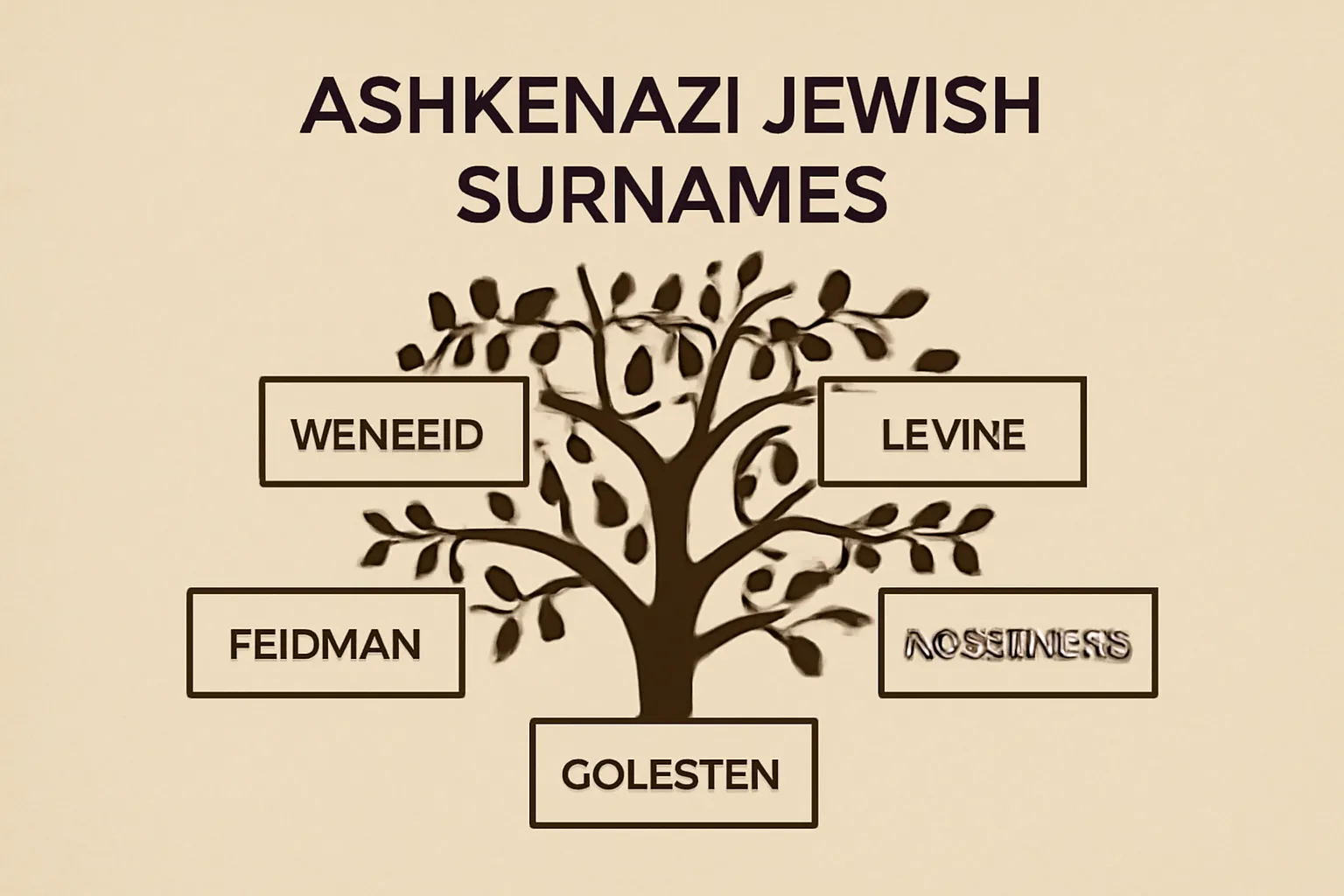
Ashkenazi Jewish surnames are the family names traditionally found among Jews who trace their ancestry to Central and Eastern Europe, especially communities in the Germanic lands, Poland, the Czech lands, and areas of the former Russian Empire. These surnames encode layers of history, language, migration, and cultural adaptation. They reveal how familial identity was shaped by laws, social expectations, and the practical needs of communities navigating diaspora, persecution, and opportunity. In this article we explore the origins and meanings behind these surnames, how they diversified into variants, and what they can tell us about genealogical pathways across continents.
Origins of Ashkenazi Surnames
The emergence of fixed surnames among Ashkenazi Jews is a relatively modern phenomenon in the long arc of Jewish history. For many centuries, Jews used given names, patronymics, or descriptive titles rather than stable family surnames. The transformation began in earnest in the 18th and 19th centuries, under the pressure of state authorities who required Jewish communities to register families for taxation, conscription, and civil administration. This legal impetus, coupled with the social transformations of emancipation and assimilation, led to a rapid consolidation of surnames that would be passed from generation to generation.
The process varied by region and empire. In the Habsburg territories, German-speaking provinces, and nearby areas, bureaucrats urged Jews to adopt Germanic or local-language surnames. In the Russian Empire and Poland, similar mandates produced a wide array of new names, often formed from German, Slavic, or Hebrew roots. As a result, Ashkenazi surnames exhibit a remarkable diversity of linguistic and cultural layers—reflecting centuries of contact among Yiddish-speaking communities, Central European cultures, and scripts such as Hebrew, Cyrillic, and Latin alphabets.
The process of adopting fixed surnames did not erase earlier naming practices; instead it layered them. Many families retained or retroactively aligned multiple elements, such as a patronymic basis (son of X), a place of origin, or an occupation, and then attached a Hebraic or vernacular descriptor to create a lasting surname. Over time, these names migrated with people to new lands—America, Palestine/Israel, Britain, South Africa, and beyond—where they further morphed through immigration, spelling changes, and local pronunciation.
In considering the origins, it is useful to recognize several broad typologies that recur in Ashkenazi surnames. These are not mutually exclusive categories, and many surnames fit more than one pattern:
Types of Ashkenazi Surnames
Patronymic and Matronymic Surnames
A large share of Ashkenazi surnames derive from the given names of ancestors, often using a patronymic construction. This means a surname signals “son of” or “daughter of” a particular father or mother. In many cases, the form has become a fixed family name across generations.
Examples rooted in patronymics include Abramson, Jacobson, Rubenstein, and Levin-derived lines like Levinson or Levi variants such as Levine.
Less common but still present are matronymic traces, where a mother’s name becomes the basis, producing forms such as Rivka-derived surnames or blends that honor a female lineage. In practice, matronymics often appear as a suffixal or compound element, especially when combined with a patronymic or with a place-based element.
The most prevalent patronymic roots in Ashkenazi family names tend to encode a biblical or Hebrew given name—think Kohn (often associated with Kohen, the priestly line) and its many derivatives, or Jacob leading to Jacobs, Jacobson, and similar forms. A respected cluster of names—such as Abrams, Abramson, or Abrahams—shows how a single patriarch’s name can radiate across generations.
Occupational and Descriptive Surnames
Some Ashkenazi surnames crystallized around occupations, trades, or distinctive physical or character traits. These often appear as descriptive or occupational surnames and can reflect a family’s traditional livelihood or notable attributes observed by the community.
Goldman, Goldstein (gold-related occupations or symbolism), Friedman and Friedman variants (associated with peace or a person named Fried), and Weiss (white, sometimes described hair color or complexion).
Schwartz (black, often describing hair color or a dark garment), Roth (red), and Klein (small) illustrate how descriptive markers could become family identifiers.
Composite occupational surnames such as Gottlieb (God-loved) also show a blend of religious meaning with personal attributes.
These descriptive and occupational patterns often blended with broader linguistic layers. A surname like Goldberg (golden mountain) or Weinstein (wine stone) marries a color or material with a natural feature, creating a memorable toponymic-feeling surname that is nonetheless rooted in descriptive language.
Toponymic Surnames
Toponymic surnames tie a family to a place—often the town, city, or region where the family lived or worked. In Ashkenazi communities, these suffix-rich forms frequently denote origin and can point to a variety of European locales.
Berliner (from Berlin), Hamburger (from Hamburg), and Löwenberg or Lipschutz (linked to place-based naming traditions, though the latter can also incorporate other elements).
Lodzner or Lodzer (from Łódź), Lwow or Lwowicz (from Lviv/Lwów), and Cracow-inspired forms such as Cracov or Cracover in some variant spellings.
Toponymic names frequently combine with -er/-ar/-nik suffixes in Yiddish and Polish-influenced spellings, producing forms like Berliner, Grodziskier, or Warschauer (from Warsaw, in some transliterations).
Toponymic surnames can be especially informative for genealogists, because locating the town or region named in a surname helps narrow down historical records, migration patterns, and family histories across borders. They also invite attention to historical geography, as changes in borders and city names over centuries can complicate tracing.
Ethnonyms, Clan Names, and Religious-Identity Elements
Some Ashkenazi surnames reflect religious roles or identity markers that were meaningful within Jewish communities. A number of forms are connected to priestly or scholarly lineage and to rabbinic associations.
Cohen (also Kahn, Kogan in some variations) that signified priestly status, with variations like Kohn or Katz (an acronym for Kohen Tzedek, often treated as a standalone surname).
Rabinowitz, Rabin-related names (often linked to a rabbi’s lineage or a family that served as community teachers).
Levin/ Levi family lines that connect to the Biblical tribe of Levi and are among the most widespread Ashkenazi surnames.
Common Surname Endings and Their Meanings
A hallmark of Ashkenazi surname morphology is the prolific use of certain suffixes that encode geographic, descriptive, or kinship information. Understanding these can illuminate a surname’s likely origin and path through history.
-berg and -burg (mountain or fortress) as in Rosenberg, Goldberg, Rothberg.
-stein (stone) as in Rosenstein, Levinstein, Goldstein.
-wald or -waldt (forest) as in Rosenwald, Weinwald.
-man (person associated with) as in Friedman, Weissman, Rosenman.
-witz or -vic (Slavic-influenced suffixes, often from Polish or Ukrainian areas) as in Radzewicz—note: many variational forms exist depending on local languages.
-sky or -ski (adjectival forms from Polish, Ukrainian, or Russian influence) as in Polanski (Polish origin associated with Poland), Landinsky.
-owski, -ev, or -in endings from Slavic languages in names like Rubinstein or Rabinovicz.
-baum (tree) and -bauer (farmer/agricultural worker) in forms like Weinbaum or Gansbauer—less common, but illustrative of how occupations and natural imagery entered surname pools.
Illustrative Examples: Variations and Etymologies
Below is a non-exhaustive gallery of Ashkenazi surname variants, grouped by origin type. For each, you’ll find a brief note on meaning and typical linguistic path.
Cohen, Kohn, Katz, Edelman — priestly lineage, tzedek (righteousness), and related rabbinic associations; the Katz variant is often linked to the acronym for Kohen Tzedek.
Levi, Levin, Levinson, Levine — rooted in the Levite line; widespread through Ashkenazi communities with many spelling variants depending on local transliteration.
Rosen, Rosenberg, Rosenfeld, Rosenblatt — rose as a motif; common as descriptive or decorative surnames in Germanic-speaking areas.
Rabinowitz, Rabin, Rabinovitz — rabbinic lineage or scholarly heritage; transliteration variations reflect Yiddish and Slavic influences.
Weiss, Weisz, Weinstein, Weissman — white color or symbolism; often carried in regions with Germanic language influence.
Schwartz, Schwarz, Schwarcz — black or dark features; variations appear across German- and Yiddish-speaking communities.
Friedman, Freedman, Friedmanov — peace or gladness connotations; common in many Ashkenazi households with various endings across languages.
Berliner, Hamburger, Cracowicz (and other city-linked forms) — classic toponymic surnames tied to places of origin or current residence.
Katz, Katznelson, Karpel — a cluster of names with religious or community-related roots; often heavily regional in distribution.
Garfinkel, Goren, Goldberg — hybrid forms combining descriptive color/material, with place- or occupation-related segments.
Regional Variations and Linguistic Influences
The tapestry of Ashkenazi surnames reflects centuries of linguistic contact among German, Yiddish, Polish, Russian, Ukrainian, and Hebrew strings of meaning. As families migrated, the spellings often shifted to fit the dominant land language or the orthographic conventions of mail, immigration paperwork, or census records.
Germanic influence is evident in many core surnames—so-called German-style endings such as -berg, -stein, -mann, and -wald.
Yiddish transliteration can produce double letters, vowels that shift with pronunciation, or alternate consonant spellings—e.g., Weiss vs. Weisz, Rosen vs. Rosen (same sound with different spellings in diaspora).
Polish and Slavic suffixes such as -witz, -ski, -icz, and -sky appear in names that trace to Polish or Ukrainian settings, visible in names like Radzewicz, Grynberg, or Nowakowski lineage forms.
Hebrew formalization comes through names that either preserve biblical roots (Cohen, Levi) or are adapted into Hebrew-influenced forms in Israel and in diaspora communities that maintain religious naming conventions.
Regional Histories and Diaspora Trajectories
The spread of Ashkenazi surnames mirrors major 20th-century migrations, including waves to the United States, Canada, the United Kingdom, South Africa, and Israel. Each geography introduced new phonetic realities and bureaucratic requirements that shaped how families wrote their names on documents, school records, and naturalization forms.
America saw a mix of preserved spellings and anglicized variants, with some families adjusting to phonetic norms of English-speaking society—leading to forms like Goldman vs. Goldman staying stable or becoming Goldman with occasional simplifications.
In Israel, many Ashkenazi families Hebrewized or revived traditional roots, yielding surnames that align with Hebrew phonology, while others remained in their European forms as a bridge to ancestral memory.
Across the United Kingdom, France, and South Africa, surname variants traveled with immigration and often underwent spelling standardization for official records, sometimes producing new double-consonant or diacritic-absent versions.
Notable Surnames: Etymologies, Variants, and Cultural Echoes
Some Ashkenazi surname families have become recognizable in historical or genealogical literature due to their frequency, notoriety, or distinctive etymology. Understanding their origins helps illuminate broader naming patterns within Ashkenazi society.
Cohen and Kohen lineages appear across many countries; their variants include Koenig, Kahn, and Katz, each carrying a slightly different genealogical coloring depending on region and spelling conventions.
Levi and Levin-family names frequently branch into Levi-inclusive derivatives such as Levinson, Levinsohn, and Levine.
Rosen, Rosenberg, Rosenfeld, and Rosenblatt illustrate how a simple floral or natural metaphor (the rose) can seed a family of surnames across multiple generations.
Schwartz and Weiss anchor a common descriptive vocabulary—color-based surnames that reflect traits observed by communities and then codified in legal registries.
Berliner and Hamburger demonstrate how toponymy reinforces a sense of geographic origin even as families migrate far beyond their homeland.
How Surnames Are Used in Genealogical Contexts
For researchers and curious readers, surnames are a starting point for tracing family history, language shifts, and immigration patterns. They can help identify:
Possible regional origins based on suffixes or common language forms.
Historical census records, ship manifests, and naturalization papers where the name might appear in a variant spelling.
Connections to religious communities (e.g., priestly lineages via Cohen/Katz clusters) and to rabbinic families.
Patterns of spelling changes driven by immigration language contexts, such as the simplification of consonant clusters or the adaptation to English phonetics.
Practical Guides: Interpreting Common Surname Clues
When examining an Ashkenazi surname, consider the following practical clues to interpret its origin and possible variants:
Look for root words that signal occupation, color, or nature (for example, Weiss = white, Schwartz = black).
Notice geographic hints in endings or root terms (e.g., -er as a demonym in Berliner or -witz as a Slavic-influenced suffix).
Identify biblical or religious indicators such as Kohen or Levi associations, which can anchor genealogical lines in priestly or Levitical origins.
Consider potential regional spellings that emerged through emigration, such as shifting from Umlauts in German to simple vowels in English contexts (for example, Weisz vs. Weiss).
Modern Trends: Surnames in the Diaspora and in Israel
In contemporary times, Ashkenazi Jewish surnames continue to evolve, reflecting ongoing identity formation, intermarriage, and linguistic adaptation. In Israel, many families either preserve their original Ashkenazi spelling or adopt Hebrewized forms that align with the Hebrew alphabet and modern Hebrew pronunciation. In the diaspora, especially in North America and the UK, people frequently encounter a broader spectrum of spellings due to transliteration choices, clerical defaults, and sometimes immigration-era bureaucratic orders.
Some families maintain double-barreled surnames that merge historical lines or reflect married names, a practice common in English-speaking countries.
Others adopt alternative spellings to better fit local languages or to avoid discrimination, a phenomenon that has complicated genealogical searches in some cases.
New hyphenated forms sometimes appear as a response to personal or family preferences, particularly among younger generations seeking explicit heritage markers.
Case Studies: Name Variants Across Regions
The following mini-case studies illustrate how a single root surname proliferates into a family of variants when encountered in different countries and historical moments.
Cohen and its cousins: In the United States, you may encounter Kohn, Katz, or Coen as variants, reflecting Germanic, Hebrew, or Anglicized spellings respectively. In Israel or Hebrew-speaking communities, Kohen or Koen are common, preserving the priestly identity in the modern state.
Levi and its derivatives: You might see Levin, Levine, Leviant, or Levinson, depending on local phonology and the era of record-keeping. These variants often co-exist within the same extended family across continents.
Rosen family lines: The sequence Rosen, Rosenberg, Rosenfeld, and Rosenblatt demonstrate a core rose-root with escalating descriptive or geographic suffixes, appearing in German-speaking regions and then spreading through diaspora networks.
Hamburger and Berliner examples: Beginning as toponymic descriptors tied to city origins, these names often migrated with people who moved to the Americas or Israel, sometimes giving rise to mixed forms like Hamberger or Berlin in transcription.
Research and Genealogy: Methods for Tracing Ashkenazi Surnames
If you are exploring an Ashkenazi surname for family history, here are practical steps that can help illuminate origins and connections:
Consult civil registration records, church or synagogue archives, and immigration manifests that may preserve variant spellings of a surname across time.
Use regional name dictionaries and etymology references that catalog endings like -berg, -stein, -witz, or -sky and explain how they arise in different languages.
Cross-check with censuses and passport applications to see how names were transcribed by authorities in different countries and eras.
Explore religious lineage records for priestly or Levitical lines (Cohen, Levi, Rabinowitz variants) that can anchor genealogies in a sacerdotal or scholarly tradition.
Consider phonetic and transliteration shifts when comparing surnames across languages—what appears as one spelling in English records may have several corresponding spellings in Polish, German, Ukrainian, or Hebrew manuscripts.
Common Myths and Misconceptions About Ashkenazi Surnames
There are several myths that can cloud understanding of Ashkenazi surname origins. A few clarifications help keep expectations grounded:
All Ashkenazi surnames are fixed and ancient. In truth, many fixed surnames were created in the last two centuries; earlier naming practices often relied on patronymics, occupations, or nicknames that were not hereditary in the modern sense.
Surnames reveal a single origin for a family. The same surname can appear in diverse regions and branches; migration, intermarriage, and language shifts mean a single name can encode multiple historical pathways.
Spelling variants imply different families. Variants may reflect the same lineage reshaped by language and record-keeping; genealogists look for phonetic continuity and corpus evidence across records.
How to Talk About Ashkenazi Surnames: Key Terms
To help readers engage with naming histories, here are some essential terms in bold that often recur in scholarship and genealogical discussions:
Patronymic (name derived from a father’s name)
Matronymic (name derived from a mother’s name)
Toponymic (name derived from a place)
Ethnonymic (name related to ethnic or tribal affiliation)
Suffixes such as -berg, -stein, -witz, -ski, and -baum as markers of origin or meaning
Notes on Pronunciation and Spelling
Pronunciation of Ashkenazi surnames can vary widely depending on regional accents and the language of record-keeping. The following are general tendencies you may encounter:
Germanic vowels may shift when transmitted through Yiddish or English, turning ei into ay or ey, or softening consonant clusters in English-dominated records.
Prefix-like elements such as van- or de- are usually not native to traditional Ashkenazi surnames; if present, they may reflect later accommodation to other linguistic contexts rather than ancient roots.
In Hebrew-speaking contexts, readers may encounter final forms or quadraliteral scripts representing consonant sequences that differ from Latinized spellings.
Conclusion: The Living History in a Surname
Ashkenazi Jewish surnames are not just labels; they are condensed chronicles. They encode the legal impositions of empires, the linguistic creativity of communities, and the migratory waves that carried families across oceans and continents. By examining the roots—patronymic echoes, occupational markers, toponymic anchors, and the multilingual milieu in which these names evolved—we gain a richer understanding of Jewish history in Europe and in the diasporas that followed.
Whether you encounter a surname like Levi, Rosenberg, Goldstein, or Berliner, you are looking at a living thread that connects present-day descendants to centuries of stories, laws, and cultural exchange. For scholars, genealogists, students, or curious readers, the study of Ashkenazi surnames offers a compelling lens into how communities used language, law, and imagination to sustain identity through shifting landscapes.