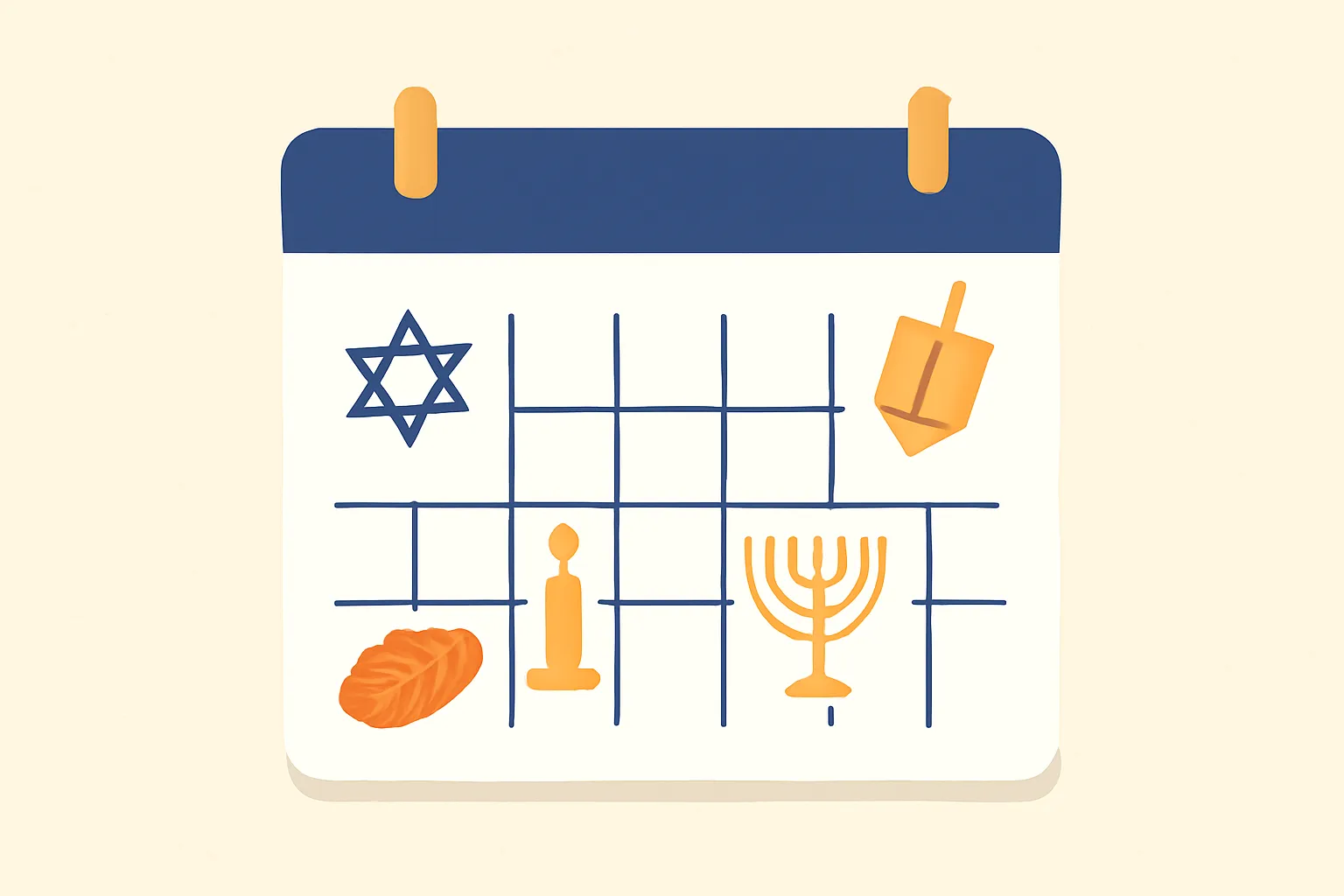
Calendar with Jewish Holidays 2026: Printable Schedule and Jewish Holiday Calendar
A calendar with Jewish holidays combines the rhythm of the civil year with the sacred cadence of the Hebrew calendar.
For families, schools, synagogues, and workplaces, having a clear, printable Jewish holiday calendar in 2026 helps
plan vacations, child care, religious observances, and community events. This article explains how to read a calendar of Jewish holidays, why the
dates shift year to year, and how to assemble a practical, printable schedule that can be used at home or in the classroom.
In Jewish tradition, dates are anchored in the Hebrew calendar, a lunar-based system with occasional leap months to keep the
seasons aligned with the solar year. The result is that the same holiday moves through the Gregorian year from one year to the next. In 2026, a Jewish holiday calendar will show the fall holidays in September, the spring festivals in March–April, and other observances scattered
through the months. This article presents the core holidays, notes typical observance patterns, and offers practical guidance for creating your own
printable schedule that works for your locale—whether you observe from the diaspora or from Israel.
The aim here is to provide a detailed, printable schedule and an informative Jewish holiday calendar overview. You’ll find clear
explanations of each holiday, typical duration, whether two days are observed (as is common outside Israel for certain holidays), and practical tips for
families and organizations planning around these dates. While the exact Gregorian dates for 2026 are listed where possible, the most reliable source for precise
timing remains local or national calendars and established Jewish calendars (such as Hebcal or Chabad’s calendar) that publish the official dates each year.
Understanding the structure: how to read a calendar with Jewish holidays
A Jewish holiday calendar typically includes two essential date systems:
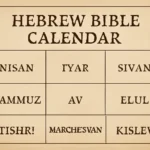
Hebrew dates: The calendar is anchored in the Hebrew month system (Nisan, Iyar, Sivan, Tishrei, Kislev, Tevet, Shevat, Adar, etc.). Holidays
are named by their Hebrew date (for example, 1 Tishrei for Rosh Hashanah, 15 Nisan for Passover).
Gregorian dates: The civil calendar dates in which those Hebrew dates fall in a given year. Because the Hebrew calendar is lunar, the Gregorian
dates shift from year to year. A well-made calendar for 2026 will present the corresponding Gregorian dates for planning purposes, while also noting
the Hebrew date so that observant readers can align their personal calendars with the religious timetable.
When you print a calendar with Jewish holidays, you typically want:
Clear labeling of each holiday with both the Hebrew date and the Gregorian date window.
Notes on duration (many holidays last one or two days, and some communities observe holidays differently in Israel vs. the diaspora).
Observance notes for families, schools, and workplaces (for example, school holidays, synagogue services, or work-day adjustments).
Space for personal entries (family birthdays, school events, cantorial rehearsals, or travel plans).
The following sections provide a practical layout of the major holidays for 2026, with guidance on how to assemble a printable schedule that
you can print or save as a PDF. If you plan to use a single Jewish holiday calendar across a classroom or family, consider creating a
two-page spread: one for fall holidays and one for spring holidays, with a compact legend that explains what each symbol or color means.
The main holidays in 2026: a practical outline for a printable schedule
Rosh Hashanah (1–2 Tishrei)
Hebrew date: 1–2 Tishrei
Estimated Gregorian window: early September 2026 (roughly around September 11–13, 2026). Note that the exact dates depend on the lunar cycle and leap years in the Hebrew calendar.
Duration: two days of festival observance in most communities outside Israel; one day in some Israeli communities with different practices.
Observances: begins with Erev Rosh Hashanah (the eve), includes prayers for a sweet new year, and is followed by a second day of celebration in the diaspora. Families may share festive meals, hear shofar blasts, and conduct introspection and wishes for the new year.
Yom Kippur (10 Tishrei)
Hebrew date: 10 Tishrei
Estimated Gregorian window: around September 20–22, 2026, depending on the sighting of the new moon and the Hebrew calendar year.
Duration: a single 25-hour fast observed in most communities; intense fasting combined with reflective prayer.
Observances: Kol Nidre on the eve, full-day synagogue services, and fasting for most adults. In communities with children, some practical accommodations are made for younger participants.
Sukkot (15–21 Tishrei)
Hebrew date: 15–21 Tishrei
Estimated Gregorian window: late September to early October 2026 (roughly Sep 25–Oct 1). The festival begins immediately after Yom Kippur and runs for seven days, with an additional one or two days of celebration in the diaspora for Shemini Atzeret and Simchat Torah.
Observances: dwelling in the sukkah, waving the lulav and etrog, festive meals, and community celebrations. In Israel, some components may be observed differently than in the diaspora.
Shemini Atzeret and Simchat Torah (22–23 Tishrei)
Hebrew date: 22–23 Tishrei
Estimated Gregorian window: early October 2026 (around Oct 2–3). Shemini Atzeret is observed on the first day, and Simchat Torah is celebrated on the following day in most communities outside Israel.
Observances: ceremonial prayers for rain (in some years), festive Torah-reading celebrations, and joyous processions with dancing and reading of the Torah.
Hanukkah (25 Kislev–2 Tevet, eight days)
Hebrew date: 25 Kislev–2 Tevet (eight days)
Estimated Gregorian window: December 2026, typically spanning early to mid-December (for example around Dec 2–Dec 10, 2026, though exact dates depend on the Hebrew calendar that year).
Observances: lighting the menorah each night, contemporary additions include special foods, gifts for children, and variations by community in terms of candle-lighting traditions and public programming.
Purim (14 Adar)
Hebrew date: 14 Adar (or Adar II in leap years)
Estimated Gregorian window: typically in late winter or early spring, often around March, depending on the Hebrew year. In 2026, Purim is expected to fall in March, with exact dates contingent on the lunar cycle.
Observances: reading the Megillah, giving charity to the poor, giving gifts of food, celebratory meals, and style variations across communities.
Passover (Pesach) (15–22 Nisan)
Hebrew date: 15–22 Nisan (in Israel, the festival is observed for seven days; in the diaspora, it often lasts eight days).
Estimated Gregorian window: March–April 2026, with Passover starting on the evening of 15 Nisan and continuing for seven or eight days, depending on community practice.
Observances: removing chametz from homes, seder meals on the first two nights (for those observing in the diaspora), and extended family and community gatherings. In Israel, some communities observe seven days with one day of chametz removal or a different schedule.
Estimated Gregorian window: spring 2026, typically in May or June, depending on the lunar cycle.
Observances: reading the Book of Ruth, late-night Torah study (Tikkun Leil Shavuot in many communities), and festive dairy meals.
Practical tips for building a printable schedule
Start with the core holidays: place the major holidays—Rosh Hashanah, Yom Kippur, Sukkot, Shemini Atzeret/Simchat Torah, Hanukkah, Purim, Passover, and Shavuot—on the calendar with their Hebrew dates and the approximate Gregorian date windows for 2026.
Indicate duration and observance style: note two-day observances outside Israel and one-day observances in Israel for certain holidays; add notes about fasting, candle-lighting times, or special prayers where relevant.
Color-code or symbol-tag: use color blocks to distinguish fall holidays (e.g., amber for Rosh Hashanah and Yom Kippur) from spring holidays (e.g., green for Passover and Shavuot) to aid quick planning.
Leave space for personal entries: include margins for family events, school breaks, synagogue programs, and travel plans that relate to the holiday schedule.
Provide a quick reference legend: offer a brief key at the bottom or side of the page that explains what each symbol, color, or abbreviation means (for example, “fast day,” “no class,” “office closed”).
How to create a printable schedule from this article
Copy the calendar overview into your preferred word processor or a note-taking app that supports printing and PDF export.
Fill in the approximate Gregorian date windows for your time zone by consulting a current local calendar or an authoritative Jewish calendar site for exact dates in 2026.
Adjust for your community’s practice if you observe one-day vs two-day Yom Tov or if you are planning around Israel’s calendar versus the diaspora calendar.
Choose a print layout: a two-page spread (fall holidays on one page, spring holidays on the other) or a single-page compact calendar with mini-entries for each holiday.
Save as a PDF for archiving or distribute as a printable handout for families, students, or staff.
Print-ready layout ideas: how to present a “Jewish holiday calendar” for 2026
For educators and organizers, a printable schedule can be structured as a simple monthly outline with each month listing the holidays that fall within it. The fall months (roughly September to October) will feature Rosh Hashanah through Simchat Torah, while the spring months (roughly March to June) will highlight Purim, Passover, and Shavuot. If you need a quick-start template, consider a two-page layout:
Page 1: Fall holidays and the lead-up to Sukkot (Rosh Hashanah, Yom Kippur, Sukkot, Shemini Atzeret, Simchat Torah).
Page 2: Winter through spring holidays (Hanukkah, Purim, Pesach, Shavuot) and fall-back notes for celebrations in the classroom or workplace.
A Jewish holidays calendar for 2026 can also be created as a set of monthly grids with the Hebrew date in a small column next to the major holiday name. This approach is especially useful for families who want to cross-reference Hebrew dates with daily schedules, or for schools that need to align holiday observances with academic calendars.
Israel vs. diaspora: two common observance patterns to note in your calendar
A critical distinction in any calendar with Jewish holidays is whether it follows the diaspora pattern (where many holidays are observed for two days outside Israel) or the Israel pattern
(where some holidays are observed for a single day). This distinction affects the duration, school closures, and synagogue scheduling:
Diaspora pattern: Rosh Hashanah, Yom Kippur, Sukkot, and Simchat Torah are often observed for two days. Purim, Hanukkah, and Passover are typically observed with the standard number of days in most communities outside of Israel.
Israel pattern: Some holidays run for a single day, and certain festive customs differ. A printable schedule for Israel may show fewer days of observance for a few holidays and can reflect local time-keeping and synagogue practices.
When planning, it’s wise to clearly mark which sections of your calendar of Jewish holidays reflect diaspora practice and which reflect Israeli practice. This helps avoid confusion and ensures alignment with your community’s exact observance.
Additional considerations for a robust Jewish calendar in 2026
Beyond the major holidays, a comprehensive Jewish calendar may include fast days, special Shabbatot (Sabbaths), and minor fasts. These observances can affect school schedules, hospital or community programming, and travel plans. Consider adding a separate list for:
Minor fast days (e.g., fasts that may be observed by some communities if fasting is feasible for health reasons).
Shabbatot and special Sabbaths that have liturgical or communal themes, which can influence synagogue services or family routines.
Education and youth programs that align with specific holidays (for example, Sunday school lessons focusing on a particular festival or mitzvah).
Travel and family time planning around long festival periods when families may be visiting relatives or taking vacations.
Glossary of terms you’ll encounter in a calendar with Jewish holidays
For readers who are new to the Jewish calendar, here are quick definitions of common terms you’ll see in a holiday calendar:
Hebrew calendar: The lunar-based calendar used to determine Jewish holy days, with occasional leap months to align with the solar year.
Hebrew date: The date on the Hebrew calendar (for example, 1 Tishrei).
Gregorian date: The civil date on which a Jewish holiday falls in a given year.
Two-day Yom Tov: In the diaspora, certain holidays are observed for two days; in Israel, some may be observed for a single day.
Seder: A ceremonial meal or ritual reading, particularly central to Passover (Pesach).
Why this article emphasizes a printable approach
A printable schedule is especially useful for households, schools, and organizations that need a stable, shareable reference. An annual or semester-long calendar with Jewish holidays helps coordinate religious observance with public holidays, parent-teacher conferences, and community events. A printable format
is ideal for bulletin boards, classroom handouts, or personal planning, and it can be kept as a physical reminder or saved as a PDF for offline access.
Conclusion: building your own Jewish calendar for 2026
A calendar with Jewish holidays for 2026 is a practical tool for planning, learning, and participation in community life. By understanding the dual
date system (Hebrew and Gregorian), recognizing the diaspora vs. Israel observance patterns, and using a printable layout, you can ensure that the year’s sacred and
social rhythms are navigable and meaningful. Whether you call it a Jewish holiday calendar, a calendar of Jewish holidays, or a Hebrew calendar,
the core purpose remains the same: to help people observe, celebrate, and learn in a structured, thoughtful way.
For precise Gregorian dates in 2026, consult a trusted, up-to-date source like a local synagogue’s calendar, your community’s school calendar, or established Jewish calendar
sites. Examples include comprehensive online calendars that publish the exact calendar for the year, with buttons to convert Hebrew dates to Gregorian dates and vice versa.
These resources ensure your calendar with Jewish holidays is perfectly aligned with your locale and community practices.
If you’d like, you can copy the layout of this article into a document and adapt it to your needs. Use bold formatting to emphasize the key holiday names and
the essential ideas of planning, and keep a separate legend for colors or symbols. By combining the structure of a printable schedule with
the seasonal flow of the Jewish holiday calendar, you’ll have a durable tool that serves families, schools, and communities throughout 2026 and beyond.
Note: Exact Gregorian dates can vary by community and year. Always verify with a current, reputable calendar of Jewish holidays for 2026 before purchasing, printing, or distributing a schedule.