The Ancient Hebrew Calendar has shaped Jewish religious life for millennia. It is best understood as a lunisolar system that marries the lunar cycle of months with the solar year to keep sacred festivals in their proper seasons. Across centuries, multiple calendar varieties persisted or competed—from an observational, temple-centered approach in ancient Israel to the highly structured, fixed calendar later adopted by Rabbinic authorities. This article surveys the history, the months, and the dates of the calendar, highlighting how ancient communities calculated time, kept track of days, and preserved continuity in the face of change.
The calendar in ancient Israel was not a single, unchanging notebook of dates. Instead, it emerged from a confluence of agricultural needs, liturgical requirements, and evolving religious authority. In the earliest Biblical and Second Temple periods, timekeeping rested on observations of the moon and the determination of months by community witnesses. Over time, a more formal system—designed to keep months aligned with the agricultural year and with the annual cycle of festivals—took shape. This evolution can be roughly traced through several phases: the observational lunar calendar of the early tradition, the temple-era annual cycles tied to agricultural and sacrificial calendars, and the eventual establishment of a fixed lunisolar calendar under rabbinic authority.
Early lunar and lunar-solar notions
In the earliest period, the beginning of a new month was primarily a matter of witnessing the new crescent or interpreting the new moon based on astronomical expectations. The calendar did not exist as a sealed algorithm; rather, communities looked to the sky, to witnesses, and to temple ritual schedules to regulate months. The names of months—often tied to agricultural cycles and seasonal markers—appear in Scripture and later rabbinic texts, and they served as the backbone of timekeeping during the biblical era.
Temple era and the public decree of new months
During the Temple period, the political and religious center in Jerusalem played a central role in declaring new months. The Sanhedrin and other authorities could convene to confirm or adjust the calendar in light of the observed moon and season. Festivals such as Passover and Sukkot were anchored to specific months (for example, Nisan for Passover), so aligning months with the agricultural cycle was essential for the people’s religious life and national cohesion.
Interplay with agricultural life and the solar year
Israel’s climate and seasonal needs meant that months could drift relative to the seasons if left purely lunar. For that reason, a lunisolar approach—combining lunar months with rules to keep the calendar in step with the solar year—began to take shape. Festivals and agricultural duties depended on the timing of months like Nisan, Tishrei, and Cheshvan, so the calendar gradually incorporated fixed patterns to preserve seasonal fidelity.
The months of the year in the ancient Hebrew calendar
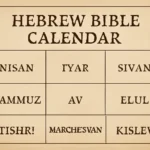
The core structure of the calendar is built around a cycle of twelve lunar months in ordinary years, with an occasional addition of a leap month in certain years to restore alignment with the solar year. The names of the months—and their order—have remained influential across Jewish history, even as the length of some months fluctuated in different calendar variants.
Nisan (also called Aviv in some traditions) – typically 30 days.
Iyar – typically 29 days.
Sivan – typically 30 days.
Tammuz – typically 29 days.
Av – typically 30 days.
Elul – typically 29 days.
Tishrei – typically 30 days.
Cheshvan (also called MarCheshvan) – length varies; often 29 or 30 days.
Kislev – length varies; often 29 or 30 days.
Tevet – typically 29 days.
Shevat – typically 30 days.
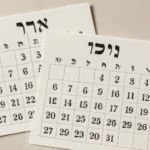
Adar – typically 29 days; in leap years this month is split into Adar I (30 days) and Adar II (29 days).
The sequence above reflects the common structure of the religious and civil year in later periods. In the civil year, some communities counted the year from Tishrei, making the autumn festival cycle the anchor of the calendar, while in other contexts the spring months—culminating in Nisan and Pessah—made the Nisan year a primary reference. The variation in Cheshvan and Kislev lengths allows the calendar to produce a 353–355-day common year or a 383–385-day leap year, ensuring seasonal alignment across cycles.
Month lengths and leap year pattern
In the traditional system, months alternate between 29 and 30 days in most cases, but two months—Cheshvan and Kislev—are variable. The length of the year is adjusted by making these two months shorter or longer to achieve the correct total days for the year. In a common year, the possible lengths are:
In a leap year, an extra month is added by introducing Adar I and keeping Adar II as a separate 29-day month. The leap year lengths become:
Short leap year: 383 days
Regular leap year: 384 days
Complete leap year: 385 days
The leap years occur in a fixed 19-year cycle: years 3, 6, 8, 11, 14, 17, and 19 of the cycle contain an extra month. This Metonic-style intercalation is central to maintaining cadence between the lunar cycle and the solar year within the fixed calendar that arose in late antiquity.
Dates, days, and how the calendar is used to count time
In both ancient and later Jewish usage, the counting of days and months hinges on a few core conventions. The day in the Hebrew calendar begins at sunset, continuing until the next sunset. Months are typically counted from their new moon, and festivals are anchored in specific months. The date notation in Hebrew uses a year, a month, and a day: for example, 11 Tishrei 5784 would denote the 11th day of the month of Tishrei in the Hebrew year 5784.
Molad and postponement rules in the fixed calendar
In the refined, fixed lunisolar calendar that eventually became normative, timekeeping relied on the Molad—the mean conjunction of the moon with the sun. The calendar employs a system of postponements, or dehiyyot, to ensure holidays avoid certain days of the week and to maintain other constraints. The most well-known rules are:
Lo ADU Rosh: Rosh Hashanah cannot occur on Sunday (A), Wednesday (D), or Friday (U).
Shabbat or other days may be invoked to defer the start of the year when the molad falls at inconvenient times.
The year type (deficient, regular, complete) is chosen to keep the calendar aligned with agricultural and religious cycles.
These conventions made the calendar predictably computable and largely independent of variable Moon sightings. The result was a stable 19-year cycle that could be calculated far in advance, enabling Jewish communities around the world to share the same calendar despite geographic distance.
From observational beginnings to a fixed system
The journey from a crowd-sourced, observational system to a fixed computational calendar was not instantaneous. In the late antique period, various centers of learning—especially in the Land of Israel and Babylonia—engaged in debates about how best to anchor months to seasonal realities while preserving religious timing. Over time, the authority of rabbinic academies solidified the fixed calendar, culminating in the work of Hillel II (often dated to the 4th–5th centuries CE). His calendar codified the rules, the order of months, and the intercalation pattern into a compact, reproducible method. This fixed calendar, with its 19-year cycle of leap years and its postponement rules, eventually became the standard used by Jews across the diaspora.
Hillel II and the rabbinic consolidation
The move to a fixed calendar did not erase the older practices or the less formal observational methods. Instead, it provided a reliable framework that could be used in all communities, regardless of local horizon, witness availability, or seasonal variability. The rabbinic approach preserved the sanctity of the holidays—Passover in Nisan, Shavuot in Sivan, and Sukkot in Tishrei—while ensuring the months fit within the agricultural cycle and the solar year. The consequence was a calendar that was both theoretically elegant and practically workable for a widespread, often dispersed population.
Other calendars and regional variations in antiquity
While the canonical Jewish calendar in later antiquity settled into a fixed pattern, other calendar concepts circulated in the broader Jewish and Near Eastern world. Among these:
Qumran calendar and possible 364-day solar calendars proposed by scholars studying the Dead Sea Scrolls. Some communities in the Second Temple period may have experimented with calendars that kept a stricter solar alignment, sometimes using a 12-month system of 30 days each or a framework with fixed solar days. These approaches are debated and provide a window into the diversity of calendrical thinking during the Second Temple era.
Temple-era calendars that linked months closely to sacrificial cycles and agricultural seasons, with months named according to their agricultural and natural associations. The temple community’s timing of festivals influenced how months were observed and how the year was structured in practice.
Diaspora practices in places far from Jerusalem, where communities relied on Jewish scholars, local interpretation, and the fixed calendar once it was conceived, but also retained memory of older observational customs.
The broader landscape shows a vibrant tradition of timekeeping that blended astronomical observation, religious authority, agricultural necessity, and practical logistics. Even as the fixed calendar became normative, historical studies remind us that ancient Israelite and Jewish communities often navigated multiple calendrical modes, reflecting the diversity of life in antiquity.
The significance, interpretation, and modern relevance
Today’s Jewish communities use the fixed lunisolar calendar with the 19-year cycle, leap years, and the postponement rules that emerged in late antiquity. Yet understanding the ancient roots of the calendar adds depth to one’s appreciation of Jewish liturgy and ritual life. The calendar is not merely a tool for marking days; it is a scaffold for memory—linking Passover to the unfolding of spring, Yom Kippur to the solemn rhythm of autumn, and Hanukkah (in Kislev) to the cold light of winter near the end of the year. In this sense, the calendar itself functions as a narrative device, tying a people to their seasonal environment and to a shared cycle of sacred time.
The ancient Hebrew calendar was continuously renewed by communal practice—by witnesses, sages, and, ultimately, by rabbinic calculation. The months’ names carried memories of the land, and the holidays anchored the calendar in a cycle that was both religiously meaningful and socially cohesive. The transition from an observational system to a fixed, calculable calendar did not erase cultural memory; it preserved continuity in ritual life while enabling a scale of community beyond local year-round cycles.
Common questions about the ancient Hebrew calendar
To help readers connect with the basics and the nuances, here are concise answers to a few frequently asked questions.
Why is the calendar lunisolar? Because lunar months (29–30 days) alone drift with respect to the solar year. A lunisolar system, reinforced by intercalation rules, keeps holidays in their appropriate seasons.
What is Adar I and Adar II? In leap years, an extra month is inserted to realign the year with the solar cycle. This results in Adar I (the leap month) and Adar II (the regular Adar), with Adar II containing the normal Adar length of 29 days.
What is the relationship between the calendar and holidays? Festivals are anchored to specific months. Keeping the calendar aligned ensures that Pesach, Shavuot, Sukkot, and other holy days occur in their intended seasons.
What is the Molad? The Molad is a calculation of the mean lunar conjunction used in fixed calendars to determine when a new month begins; it supports the predictability of the calendar.
Conclusion: a calendar that weaves time, faith, and season
The Ancient Hebrew Calendar embodies a remarkable synthesis of astronomical observation, religious authority, agricultural cycles, and communal memory. From the observational lunar beginnings of the earliest periods to the fixed lunisolar system engineered by rabbinic scholars, the calendar has served as the clockwork of Jewish life. It has adapted to changing circumstances while preserving core rhythms: months named for the land, days counted from sunset to sunset, and sacred festivals that anchor a people to the cycle of the year. The variations we see—whether in the temple-era cycles, in the Dead Sea Scrolls’ calendars, or in the post-Temple adoption of Hillel II’s computable calendar—are not mere curiosities. They illuminate how ancient communities in a complex world sought to harmonize lunar cycles with solar seasons, to ensure worship and work moved in concert, and to keep time in a way that preserved memory, identity, and faith for generations.
For readers today, the story of the ancient Hebrew calendar is more than a chronicle of dates. It is a lens on how a people understood time, place, and ritual—how observation, calculation, and tradition can converge to create a durable system that sustains a lifelong rhythm of holidays, fasts, and feasts. Whether approached from the perspective of historical development, textual interpretation, or practical calendar-making, the calendar remains a living testament to an ancient civilization’s ingenuity and its enduring cultural legacy.