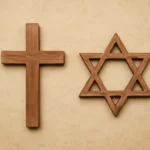
Christianity and Judaism are two of the oldest and most influential traditions in the world, sharing roots in the ancient Near East and a long history of interaction. Yet they are also distinct in fundamental ways that shape belief, practice, and community life. This article surveys the differences between Christianity and Judaism—often described as divergences in key beliefs, rituals, and historical development—while also noting the areas of shared heritage and mutual influence. The goal is to present a clear, nuanced overview that helps readers understand how these two faiths conceptualize God, scripture, salvation, and daily life, as well as how their histories have unfolded over two millennia.
At the heart of the Christian–Jewish distinction lies monotheism and how that monotheism is understood within the framework of revelation, community, and salvation. Both traditions affirm the belief in one God, yet they diverge on the nature of God, the plan of salvation, and the role of prophetic messengers.
God and the nature of divine revelation
In Judaism, God is understood as a single, indivisible, transcendent, yet immanent Creator who has entered into a covenant with the people of Israel. Revelation is understood to be ongoing through the Law given at Sinai, the prophetic voices, and the ongoing study of the scriptures and laws. The emphasis is on fidelity to the Torah (the first five books of the Jewish scriptures) and to the subsequent interpretive traditions.
In Christianity, God is likewise one but is understood through the lens of the doctrine of the Trinity (Father, Son, and Holy Spirit in unity). Christians believe that God’s fullest self-disclosure came through the life, death, and resurrection of Jesus Christ, whom they regard as the divine Son and the long-awaited Messiah. This belief leads to a sense of salvation history that unfolds through the New Covenant established by Jesus.
Jesus, the Messiah, and the Trinity
A central point of Christianity–Judaism differences concerns the figure of Jesus. Christians regard Jesus as the Messiah (the Christ) and the incarnate Son of God, whose life and sacrificial death opened the way to forgiveness and eternal life for believers. The incarnation and the atonement are foundational to Christian faith.
In Judaism, Jesus is not recognized as the Messiah nor as a divine figure. Jewish expectation of the Messiah is different: a future human leader who will restore the Davidic kingdom, repair the world, and lead people to a renewed covenant with God. The Trinity is not a concept in Judaism; God is affirmed as a single, indivisible divine being.
Scripture and authority
Scripture is the primary authority in both traditions, but the scope and interpretation diverge. Judaism centers on the Tanakh (the Hebrew Bible) and, especially in rabbinic Judaism, on the interpretive corpus of the Talmud and the midrashic literature. Jewish law (the Halakhah) develops through rabbinic decision and communal practice.
Christianity centers on the Bible, comprising the Old Testament (shared with Judaism in its earlier books) and the New Testament, which contains the Gospels, the letters of the apostles, and the Book of Revelation. Christians view the New Covenant as superseding or fulfilling the Old Covenant in light of Jesus’ life and teachings.
Salvation, afterlife, and ethics
In Judaism, salvation is understood in terms of communal and ethical fidelity within the covenant with God, with a range of beliefs about afterlife and reward that vary among different Jewish movements. Emphasis is placed on right action, justice, and repairing the world (the Hebrew term tikkun olam) as expressions of faith.
In Christianity, salvation is often framed as grace received through faith in Jesus, along with repentance and a transformed life. The concept of salvation is closely linked to the death and resurrection of Christ, which Christians believe secures eternal life for believers. Afterlife concepts also differ across Christian traditions (heaven, hell, purgatory in some denominations).
Law, covenant, and ethical life
A major Christian–Jewish difference concerns the role of the law. Judaism holds the Torah and its commandments (mitzvot) as central to Jewish life and identity. While rabbinic literature understands the law in a broad, continuous way, Jews live out the commandments as a daily practice in community, study, and ritual.
Christians typically interpret the law through the lens of grace and the teachings of Jesus. Many see the moral law as fulfilled or reinterpreted in the command to love God and neighbor, with some emphasis on the moral teachings of Jesus rather than a strict, literal observance of all ritual commandments found in the Torah.
Sacred texts, interpretation, and scholarly traditions
Sacred libraries: Tanakh, Torah, and the Christian Bible
Torah (Genesis, Exodus, Leviticus, Numbers, Deuteronomy) is foundational in Judaism as a source of divine instruction and identity.
Tanakh is the broader collection of Jewish scriptures, including the Prophets and Writings, with a distinct canon from the Christian Old Testament in order and emphasis.
In Christianity, the New Testament is essential for faith and practice, presenting the life of Jesus, the early church, and theological reflections on salvation and doctrine.
Rabbinic interpretation in Judaism involves a long tradition of debate, legal analysis, and midrashic interpretation. The Talmud and later authorities—such as the medieval Rishonim and the later Acharonim—play a central role in shaping how scriptures are understood and applied to daily life.
In Christianity, patristic and scholastic theology emerged in the early centuries, with key ecumenical councils shaping doctrine about the nature of Christ, the Trinity, and salvation. The subsequent centuries saw the rise of various denominations, each with its own interpretive traditions and authorities (for example, Scripture alone in Protestantism; tradition and Scripture in Catholicism; the practice of the early Church in Orthodox traditions).
Worship, rituals, and religious life
Worship life in Judaism and Christianity reflects their distinct theological emphases and community structures. Both traditions center prayer, sacred seasons, and life-cycle events, but the practices diverge in liturgy, rites, and calendar.
Prayer and liturgy
Judaism emphasizes communal prayer, a liturgical calendar, and daily study. Traditional prayer often occurs in a synagogue, with liturgy expressed in Hebrew and the local language, and with a strong emphasis on communal participation and accountability.
Christianity emphasizes personal faith and communal worship as a key expression of belief. Liturgy varies widely by tradition, from highly structured rites with set prayers to spontaneous, charismatic worship. Worship often centers on congregational singing, preaching, and the sacraments.
Rituals, sacraments, and rites of passage
Judaism observes Sabbath (Shabbat) from Friday evening to Saturday evening, with rest, prayer, and family-centered meals. Other major rituals include circumcision (brit milah) for boys, and the bar/bat mitzvah as rites of passage into religious responsibility.
Christianity celebrates sacraments or ordinances such as baptism and the Eucharist (also called Communion or the Lord’s Supper). The frequency and theological emphasis of these rites vary by denomination. Many Christian communities also observe liturgical seasons like Advent and Lent.
Holidays and festivals
Judaism has a rich cycle of holidays rooted in historical and agricultural memory: Passover (Pesach) commemorating the Exodus; Sukkot (Feast of Tabernacles); Rosh Hashanah (New Year); Yom Kippur (Day of Atonement); Hanukkah and more. These holidays emphasize remembrance, covenant fidelity, repentance, and gratitude.
Christianity centers its calendar on the life of Jesus, with major feasts such as Christmas (birth of Jesus) and Easter (celebrating the resurrection, with Good Friday tracing the Passion). Liturgical color, music, and interpretive reflections accompany these seasons, varying by tradition.
Life-cycle events
Judaism marks birth with naming and brit milah; coming-of-age milestones include bar/bat mitzvah and marriage within a Jewish ceremony; death is observed with specific rituals and mourning periods.
Christian life-cycle events include baptism as an entry into the faith community, confirmation in many denominations, weddings in a Christian rite, and funeral rites often reflecting belief in life after death.
History and development: origins, divergence, and continuity
The histories of Judaism and Christianity are deeply intertwined, with shared beginnings and long periods of separate development. Studying their histories helps illuminate why certain beliefs and practices look the way they do today.
Ancient roots and the emergence of Judaism
Judaism emerges from the broader faith of the Israelite people, with a distinctive covenantal identity centered on the Torah and a history of law, ritual purity, and community life. The biblical narrative tells of patriarchal traditions, temple worship, and ethical teachings that shape Jewish self-understanding. Over centuries, Jewish communities developed diverse practices, leading to the major streams seen in the medieval and modern eras: Orthodox, Conservative, and Reform movements, among others.
The life of Jesus and the early Christian movement
In the first century CE, a movement within Second Temple Judaism began to interpret Jesus as the fulfillment of biblical prophecies and as the divine in a new way. Early Christians, who were initially a Jewish sect, began to articulate a distinct worship and theological framework around Jesus’ life, death, and resurrection. The resulting separation between what would become Christianity and Judaism unfolded over several generations and was shaped by debates, doctrinal formulations, and historical events.
Medieval and early modern developments
Throughout the medieval period, Christian and Jewish communities often lived in close proximity but faced social and legal restrictions that influenced religious life. The Great Schism of 1054 CE formalized a division between Roman Catholic and Eastern Orthodox Christianity, while Jewish communities navigated changes in law, migration, and interaction with Christian societies.
The Reformation of the 16th century reshaped Western Christianity with new denominations emphasizing different understandings of scripture, authority, and salvation. In many places, this period also coincided with complex interactions between Christianity and Judaism, including debates about conversion, religious tolerance, and mutual learning.
Modern era: diaspora, emancipation, and interfaith dialogue
In the modern era, Jews and Christians experienced emancipation and new forms of civic life in various countries. The 19th and 20th centuries brought immense changes in demographics, intellectual currents, and theological reflection. The Holocaust represents a particularly tragic chapter in Christian–Jewish history, calling for renewed interfaith dialogue, memory, and responsibility. In the contemporary period, many communities engage in constructive dialogue, shared social initiatives, and scholarly exchanges that highlight their common roots while acknowledging profound differences.
intersections, shared heritage, and mutual learning
Despite clear differences, Christianity and Judaism share important historical and ethical resonances. Both traditions emphasize a commitment to justice, compassion for the vulnerable, and the pursuit of meaning through sacred texts and communal life. A nuanced look at their intersections can reveal areas of shared values as well as respectful distinctions.
Shared terrain: ethics, justice, and community
Justice and mercy motivate charitable acts, social advocacy, and personal conduct in both faiths.
Both traditions honor the importance of family life, education, and study as means of transmitting faith across generations.
Both have a long tradition of interpretive scholarship—Jewish rabbinic study and Christian biblical exegesis—that seeks to understand scripture in light of new circumstances.
Points of dialogue and respectful disagreement
The question of Jesus as Messiah and whether salvation is universal or particular to faith communities is a central area of difference, but it can be approached with mutual respect and historical awareness.
Discussions about the nature of God, the role of the covenant, and the interpretation of the law illuminate both shared convictions and divergent paths.
Interfaith education and cooperative social action provide practical avenues for collaboration while maintaining doctrinal distinctiveness.
Common questions and misconceptions
Readers may encounter a variety of questions about how Christianity and Judaism relate to each other in contemporary contexts. Below are some common themes:
Are Christians and Jews the same religion? No. They share roots and some scriptures, but they differ in theology, Christology, and covenantal understanding.
Do both traditions share the same scriptures? They share the Tanakh/Old Testament in many books, but Christians include the New Testament, while Judaism does not recognize it as sacred scripture.
Is there mutual conversion pressure today? Most reputable Jewish and Christian communities emphasize respect for each other’s faiths, with varied policies around conversion across denominations.
Conclusion: a balanced view of Christianity Judaism differences
The differences between Christianity and Judaism are profound and meaningful, touching the deepest questions about God, identity, and destiny. Yet the two traditions also bear a shared memory and a long history of interaction that has shaped theology, art, philosophy, and ethical life across centuries. A thoughtful study of these divergences and similarities can foster a more informed, respectful appreciation of what each faith seeks to offer to humanity: a path toward meaning, moral integrity, and a hopeful vision for the world.
Glossary of key terms (quick reference)
– The foundational Jewish law and teaching, part of the Jewish Scriptures.
Tanakh – The Hebrew Bible, consisting of the Torah, the Prophets, and the Writings.
Talmud – A central rabbinic text containing discussions and commentary on Jewish law, ethics, and tradition.
Halakhah – Jewish law derived from the Torah and rabbinic interpretation.
Messiah – The anointed leader anticipated in Jewish expectation; in Christianity, Jesus is identified as the Christ, the Messianic fulfillment.
covenant – A binding agreement between God and the people; central to both traditions but understood differently in each.
New Covenant – The Christian belief in the new relationship with God through Jesus Christ, superseding or fulfilling the Old Covenant in the Christian understanding.
Old Covenant – The covenantal agreement described in the Hebrew Bible, traditionally understood within Judaism as enduring for the Jewish people.
Trinity – The Christian doctrine of one God in three persons (Father, Son, Holy Spirit), not present in Judaism.
For readers who wish to explore further, consider examining primary texts from both faiths, engaging with scholars who specialize in Jewish–Christian studies, and participating in interfaith dialogues that emphasize learning, listening, and mutual respect. The differences outlined here are not merely theological curiosities; they are the living distinctions that have shaped communities, liturgy, ethics, and daily life for two of the world’s most enduring religious traditions.